HIBAPRESS – Casablanca
The Ministry of Habous and Islamic Affairs has circulated today's Friday sermon to all imams and preachers of the Kingdom's mosques. The sermon was chosen to focus on the virtue and etiquette of mosques, and the fruits of prayer within them, and it read as follows:
THE FIRST SERMON
Praise be to Allah, who made mosques dedicated to Him, singled them out for His proximity and being visited by Him. We praise Him Almighty for His abundant bestowal and pervasive benevolence. We bear witness that there is no god but Allah, alone, without partner, a testimony of one who admits his servitude to Him in all his affairs. We bear witness that our master Muhammad is the servant of Allah and His Messenger, His chosen from His creation and His intimate friend. May Allah’s peace and blessings be upon him, his pure family, his noble companions, and those who follow them in excellence until the Day of Judgment.
To proceed; Allah Almighty says in His clear verses:
"The mosques of Allah are only to be maintained by those who believe in Allah and the Last Day and establish prayer and give zakah and do not fear except Allah, so it is hoped that those will be among the guided." [1]
O community of believing men and women; In this noble verse, Allah Almighty has praised those who maintain mosques, describing them with faith, adherence to Allah's right in prayer, and the right of the poor and needy in zakah. He also praised them for their fear of Allah and their attainment of guidance.
From here, the virtue of mosques becomes apparent as they are houses of Allah, dedicated to Him in honor and distinction from the houses of people. Allah Almighty says:
"And [mention] that the mosques are for Allah, so do not invoke with Allah anyone." [2]
And Allah Almighty has permitted them to be elevated in all senses of the word, to establish His remembrance morning and evening. So He, Glorified be His mention, said:
"In houses [i.e., mosques] which Allah has ordered to be raised and that His name be mentioned therein; in them, men glorify Him in the morning and the afternoons [of every day]." [3]
The maintenance of a mosque is by building and constructing it, illuminating and furnishing it, cleaning and maintaining it, as well as by praying in it and establishing the remembrance of Allah within it. This is indicated by noble verses and prophetic traditions. Among them is the saying of the Prophet, peace be upon him:
"Whoever builds a mosque for the sake of Allah, Allah will build for him a similar one in Paradise." [4]
There was a woman during the time of the Prophet, peace be upon him, who used to sweep and clean the mosque. She died at night, and the companions, may Allah be pleased with them, prayed over her and buried her. When the Prophet, peace be upon him, missed her, he asked about her. They said: She died, and it was as if they belittled her matter and disliked waking the Prophet, peace be upon him, to pray over her. So the Prophet, peace be upon him, said:
"Why did you not inform me? Show me her grave." [5]
The Prophet, peace be upon him, prayed over her as an honor to her and for what she did in cleaning the mosque. Therefore, praying over the grave was specific to her. Ibn Hajar said:
"And in the hadith is the virtue of cleaning the mosque and inquiring about the servant and the friend." [6]
As for the etiquette of the mosque, we mention among them: the magnification of its status in hearts, as it is among the symbols of Allah that indicate His Oneness and His worship. Allah Almighty says:
"That [is so]. And whoever honors the symbols of Allah – then it is from the piety of the hearts." [7]
Mosques fall under the general category of symbols, and indeed they are the greatest in status, due to what has been narrated about their virtue and the encouragement to maintain them.
Among them is coming to them with reverence and dignity, with the intention of drawing closer to Allah Almighty. Among them is the greeting of the mosque, except at times of dislike, where it is recommended to merely remember Allah Almighty instead.
Among them is sitting wherever one finds a place upon entering it, without harming or disturbing the worshippers and those remembering Allah, by stepping over people's necks, and the like.
Among them is protecting it from disruption by worldly talk, by phones, and raising the voice unnecessarily for a benefit related to the mosque. This is due to the narration that the Prophet, peace be upon him, said:
"Whoever hears a man calling for a lost item in the mosque, let him say: May Allah not return it to you, for mosques were not built for this." [8]
Among them is protecting it from disputes and stirring up doubts about people, and the interference of those with desires and ill intentions by casting doubt on people regarding their religious matters.
O servants of Allah; by respecting these observed etiquettes regarding mosques, mosques will be preserved from what is unbecoming of their great status. Then they will fulfill their spiritual and divine mission in the best and most complete way. They will be a beacon in the neighborhood and village, guiding the lost and illuminating the path of believers to achieve a good life for people in this world, and bringing them happiness by attaining Allah's pleasure and eternal bliss in the hereafter.
May Allah benefit me and you with His clear Quran and the hadith of the master of the first and the last. Our final call is praise be to Allah, Lord of the worlds.
THE SECOND SERMON
Praise be to Allah, Lord of the worlds. And prayers and peace be upon the most noble of messengers, our master Muhammad, and upon his family and all his companions.
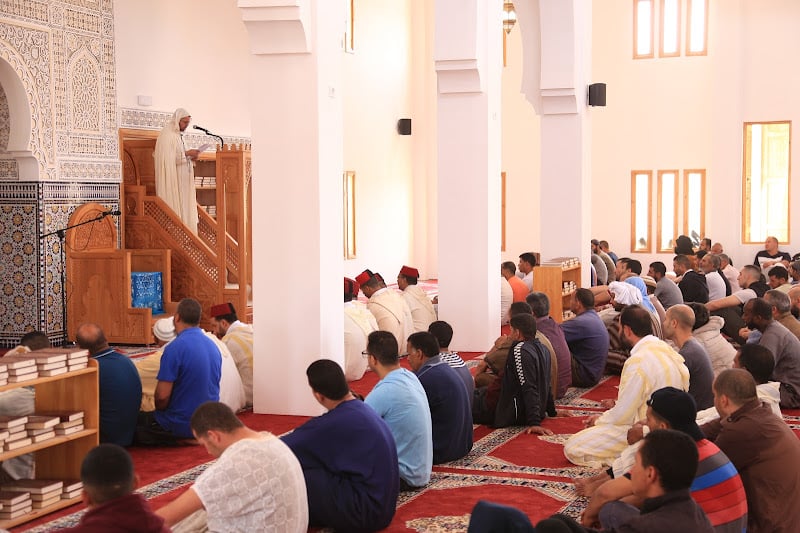
O community of believing men and women; the mosque has significant functions and noble purposes in the lives of Muslims, in establishing the remembrance of Allah Almighty, raising His symbols, nurturing the faith of believers, purifying their souls, refining their manners, and teaching them their religious affairs. Thus, the elder shows mercy to the younger, and the younger honors the elder, and mosque attendees compete in doing good to others, and other fruits that are specific to mosque attendees and with which they are characterized outside the mosque in their daily lives. The mosque, in reality, is everything, and that is the goal of the "Guidance Plan for Communication," in making acts of worship result in good morals, pure conduct, and good dealings with everyone.
The scholars have paid attention to the texts concerning the virtue of praying in the mosque with the congregation and have traced the characteristics that make
"A man's prayer in congregation is superior to his prayer in his house and his market by twenty-five parts, or twenty-seven degrees." [9]
They found a number of characteristics and etiquettes that are only present in congregational prayer. Among them are characteristics related to their relationship with Allah Almighty, such as going to the mosque for prayer, saying "Amen" with the angels, and the virtue of the rows, and others. Among them are those related to the servant's relationship with his brother, such as straightening the rows, greeting each other, the one who makes mistakes joining the group of the righteous, witnessing the supplications of Muslims, feeling the warmth of the congregation, inquiring about the absent, helping the needy, and witnessing the greatness of the religion of Islam, and other characteristics that do not come to a Muslim in his house unless he goes out for them and strives to obtain them.
Therefore, fear Allah, O servants of Allah, and maintain the houses of Allah with obedience, worship, and advising others. Increase your prayers and blessings upon the one who teaches people good, our master Muhammad, peace be upon him. O Allah, bestow Your prayers, peace, and blessings upon our master Muhammad, whenever the rememberers remember You and him, and the forgetful are heedless of remembering You and him.
And O Allah, be pleased with Your rightly guided Caliphs; Abu Bakr, Umar, Uthman, and Ali, and with the rest of the companions, the Emigrants and the Helpers, and those who followed them and their footsteps until the Day of Judgment.
And O Allah, grant victory to whom You have entrusted the affairs of Your servants and appointed as guardian of Your country, our master the Commander of the Faithful, His Majesty King Mohammed VI, with a victory through which You strengthen Islam and Muslims, and through which You fulfill for him all that he aspires to for the progress and prosperity of his people, his nation, and his homeland. And O Allah, gladden the eyes of His Majesty with his beloved Crown Prince, His Royal Highness Prince Moulay Al Hassan, supported by his dear brother, His Royal Highness Prince Moulay Rachid, and by the rest of the noble Royal family. You are the All-Hearing, the All-Responding.
And O Allah, by Your vast mercy, have mercy on the two noble kings, our master Mohammed V and our master Hassan II. O Allah, make their graves pleasant, honor their abode, and place them in a truthful dwelling with You, alongside those favored from the prophets, the truthful, the martyrs, and the righteous, and how excellent are they as companions.
O Allah, make us guided and guiding, not straying nor causing others to stray. O Allah, benefit us and elevate us. O Allah, help us in Your remembrance, Your gratitude, and Your good worship. And make the maintenance of Your houses beloved to us, so that we may be among the guided in this world and among the victorious in Your presence in the hereafter.
Our Lord, grant us mercy from You and provide us with guidance in our affair. Our Lord, give us in this world [that which is] good and in the Hereafter [that which is] good and protect us from the punishment of the Fire. Glorified is your Lord, the Lord of might, above what they describe. And peace be upon the messengers. And praise be to Allah, Lord of the worlds.