HIBAPRESS – A. Mahyaoui
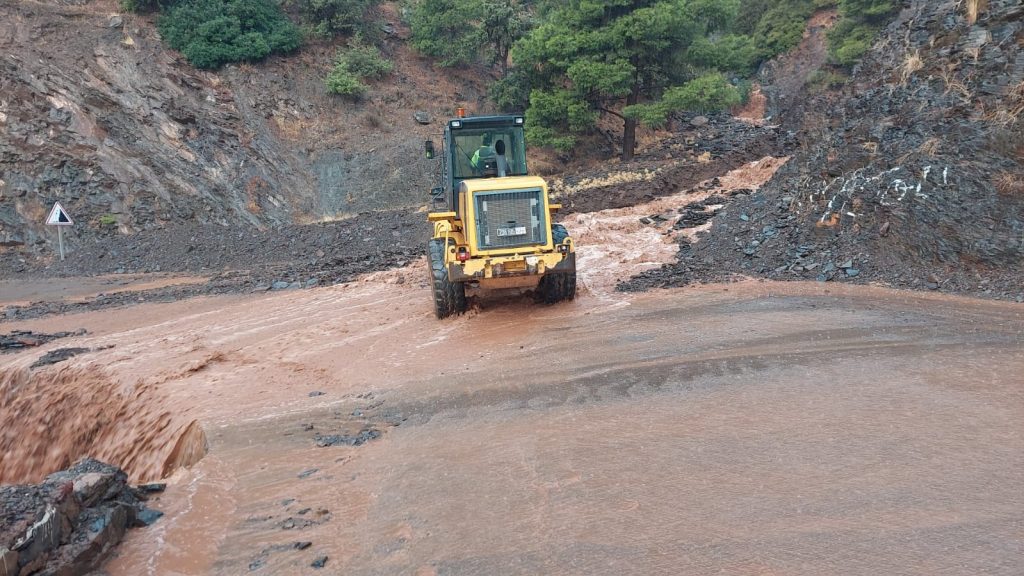
The province of Al Haouz has experienced strong thunderstorms since Friday evening, causing the water levels of several wadis and streams to rise. This has led to traffic disruptions on numerous roads and routes due to soil erosion and the fall of stones and rocks, necessitating a field mobilization to address the consequences.
Immediately after these disruptions were recorded, provincial authorities, in coordination with the relevant departments of Equipment and local authorities, initiated continuous field interventions. They mobilized essential human and logistical resources to remove obstacles and reopen damaged road arteries, ensuring the safety of road users.
In this context, interventions resulted in the reopening of several rural routes in the villages of Ait Cham Hawa, Amrto, and Asaka, belonging to the commune of Ikrafrouane, after the effects of rainfall and floods were addressed and traffic movement was restored to normal.
Traffic has also fully returned to normal on National Road No. 7, connecting Marrakech and Taroudant, following interventions that included the Marghen village, the Tibidart section of Ighzar Noumezel Wadi near Takm village, and the Talat Nourhal Wadi in the Rahha area, belonging to the commune of Asni.
Field operations also covered Regional Road No. 2017, which experienced rockfalls and soil erosion. It was reopened to traffic under safe conditions, with ongoing monitoring and intervention as needed. Rockfalls recorded at kilometer 37, adjacent to Tafza village in the Orika commune, were also cleared without traffic interruption on this section.
In the same vein, Regional Road No. 2009 was reopened at the level of Bahja Wadi after the removal of flood debris. Meanwhile, work continues to clear accumulated soil and stones on the Tamkounsi and Tamert sections of Regional Road No. 2030, connecting the communes of Asni and Imlil.
These interventions reflect the scale of mobilization underway in various areas of the province to confront the effects of weather fluctuations. The geographical nature of the region, with its rugged terrain and watercourses on some routes, demands constant vigilance and rapid intervention to ensure the continuity of movement and protect citizens from potential risks.
In this regard, the services of the Al Haouz provincial prefecture, under the direct supervision of the province's vigilant and competent governor, continue to monitor the field situation and coordinate efforts among the relevant departments. This approach involves continuous presence and responsiveness to developments, as well as alerting road and route users to the need for caution, especially in areas near wadis, streams, and sections prone to erosion.
The importance of this mobilization was evident in supporting field interventions and coordinating efforts to reopen damaged arteries as soon as possible, thereby minimizing the impact of weather disturbances on the daily lives of residents and preserving the safety of citizens and their property.
With the ongoing weather fluctuations, vigilance and coordination among authorities, technical services, and local authorities remain essential factors in dealing with any potential developments and ensuring rapid intervention when necessary, particularly in rural and mountainous areas where routes are increasingly fragile in the face of heavy rainfall and floods.