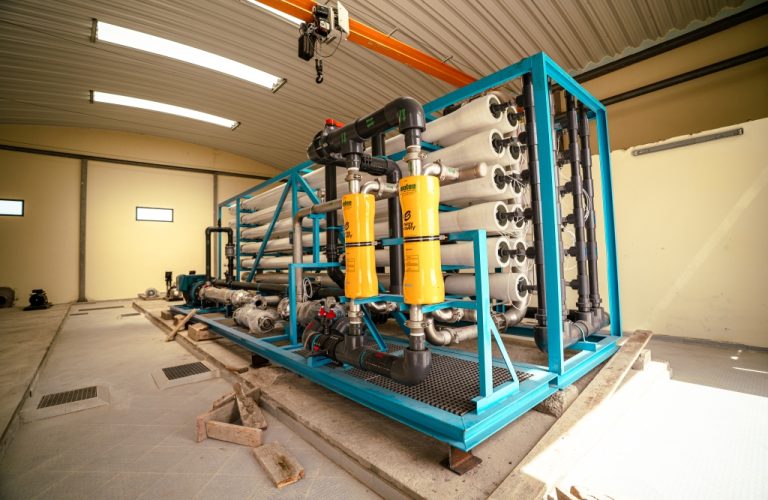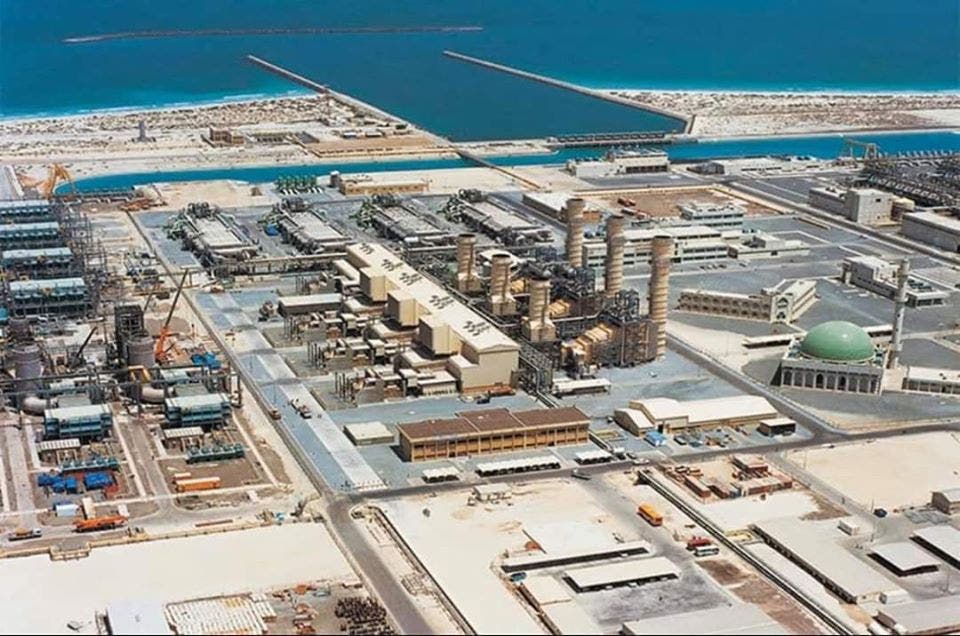
The seawater desalination plant, located in the Chtouka Ait Baha province, is a structuring and strategic work aimed at alleviating water stress and addressing the acute shortage of water resources in the Souss-Massa hydrographic basin.
With a total cost of 4.41 billion dirhams, of which 2.35 billion dirhams are allocated to the irrigation component and 2.06 billion dirhams are allocated to drinking water, this major project, the first of its kind in Africa, aims to fill the water deficit and produce new water resources.
This project, carried out through a partnership between the public and private sectors, will irrigate an area of up to 15,000 hectares in the Shtouka plain by desalinating seawater instead of groundwater, and 1,500 farms will benefit.
This hydraulic installation also produces 400,000 cubic meters per day of desalinated water, which is shared equally between drinking water and irrigation water, as it contributes to maintaining the agricultural activity that characterizes the region, particularly high value-added crops.
This ambitious project, launched in November 2017, is the result of concerted efforts and resources between the Ministry of Agriculture, Fisheries, Rural Development, Water and Forests, the National Office of Electricity and Drinking Water, institutional and professional partners, as well as authorities at regional and regional levels.
In this regard, the head of the operations department of the Southern Regional Directorate of the National Office of Electricity and Drinking Water – Water Sector, Khaled Belferda, confirmed that this station, the first of its kind in Africa, meets the needs of Agadir el-Kebir (Agadir Idaoutnan and Inezgane Ait Melloul) for drinking water, in addition to providing large quantities of water to irrigate high-value crops in the Shtouka plain.
He explained in a statement to the Maghreb Arab Press Agency that the operation of this desalination plant allows the production of 275 thousand cubic meters/day, with a flow rate of 150 thousand cubic meters/day of drinking water and 125 thousand cubic meters/day of irrigation water.
Mr. Belverda stressed that the National Office of Electricity and Drinking Water is studying the project of expanding the station to increase its capacity from 275 thousand m3/day currently, to 400 thousand m3/day by 2026.
It should be noted that in response to the challenges posed by the problem of water shortage and in accordance with the Royal Directives, a set of strategic projects have been launched within the framework of the National Program for the Supply of Drinking Water and Irrigation Water 2020-2027, with a financial envelope estimated at 115 billion dirhams.
In this context, nine new seawater desalination plants with a total capacity of 202 million cubic meters per year were created to ensure the supply of drinking water to the inhabitants of the cities of Agadir, Safi, El Jadida, Al Hoceima and Laayoune, and six Desalination plants with a total capacity of 360 million cubic meters were launched to secure the water supply. Beverages are mainly located in Casablanca, Marrakech, Sidi Ifni, Dakhla, Settat, Berrechid, Khouribga, Benjerir and Youssoufia.
In addition, a program will be launched that includes eight seawater desalination plants with a total capacity of more than 1,130 million cubic meters to ensure the supply of drinking and irrigation water, particularly in the regions and regions of the East, Souss-Massa, Tangier-Tetouan, Guelmim, Tan-Tan, Boujdour and Tarfaya.