HIBAPRESS-RABAT-According to Public Senate
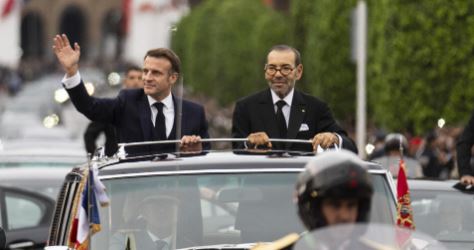
Emmanuel Macron, accompanied by a large part of the government, began a three-day state visit the day before yesterday Monday at the invitation of King Mohammed VI. Confirmation of a warming between the two countries, which began this summer with France’s recognition of Moroccan Sovereignty over Western Sahara.
It is a visit which will officially resolve long months of diplomatic crisis between France and Morocco, which began in the summer of 2021 during the revelations of the presence of the telephone number of Emmanuel Macron and several of his ministers on the Moroccan listing of the Pegasus spy system.
Monday, Emmanuel Macron, nine ministers, Jean-Noël Barrot (Foreign Affairs), Bruno Retailleau (Interior),), Sébastien Lecornu (Defense), Antoine Armand (Economy) and a hundred personalities including major French bosses, like Patrick Pouyanné, (TotalEnergies), and Rodolphe Saadé (CMA GGM), arrived in Rabat for a three-day state visit at the invitation of King Mohammed VI.
The French turn on Western Sahara
Also on the trip, Christian Cambon (LR), the president of the France-Morocco friendship group of the Senate, does not shy away from his pleasure to see that it is in front of the Moroccan Parliament that Emmanuel Macron will deliver a very important speech on Tuesday on the change of orientation of France on “Moroccan sovereignty of Western Sahara”.
For several years, this question, among others, had reduced the bilateral relationship between France and Morocco to nothing. Parliamentary diplomacy continued but in an unofficial manner. “In 2025, the Franco-Moroccan interparliamentary forum will be able to be held again. We are opening a new page of cooperation for our companies which opens the way to the rest of the African continent. This is the logical continuation of Emmanuel Macron’s letter addressed to King Mohammed VI, this summer, for the anniversary of 25 years of reign,” indicates Christian Cambon. The socialist senator, former minister delegate for French people abroad, Hélène Conway-Mouret confirms: “In recent years, I have seen my Moroccan parliamentary colleagues outside of democratic bodies. I was no longer officially invited to Parliament.”
In his missive sent at the end of July, Emmanuel Macron estimated that the Moroccan Plan constituted “now the only basis for achieving a political solution” in Western Sahara. This former Spanish colony, located in the south of Morocco, has been in conflict with the kingdom since 1975 and claims its right to self-determination. If the territory is de facto controlled by Morocco, the separatists of the Polisario Front, supported by Algeria, are demanding the organization of a self-determination referendum. After fighting between 1975 and 1991, the conclusion of a ceasefire provided for a consultation on the autonomy of the territory.
“France’s position is all the more important as it is a member of the United Nations Security Council. Other countries were waiting for this movement to position themselves. This is the case of Denmark which did so this year. In Europe, more than 15 countries have recognized Moroccan sovereignty over Western Sahara,” says Christian Cambon.
“Diplomacy is continuity. On the issue of the Sahara, the President has completely changed course, without consulting Parliament. As a result, France has lost its position of balance which could make it a mediator between Morocco and Algeria, it is all the more damaging since, unlike Spain for example, we do not we have no particular interests in this matter,” regrets Hélène Conway-Mouret for her part.
“Western Sahara is above all a question of respect for international law. France has officially taken a position in favor of the fait accompli by supporting Morocco while it is speaking out, on other issues, in favor of the self-determination process. This letter from Emmanuel Macron ultimately only resolved an ambiguity because French diplomacy on this subject has always leaned towards the Moroccan side. Since the 70s, France has never wanted to strengthen Algerian power,” explains Adlene Mohammedi, researcher and teacher in geopolitics.
Since this summer, France’s rapprochement with Morocco on this issue has logically cooled relations with Algeria and led to the withdrawal of its ambassador to Paris and reduced its diplomatic representation. Launched in 2022, the work of the joint commission of Algerian and French historians intended to “better understand each other and reconcile wounded memories” has been frozen. “This visit to Morocco is not aimed against Algeria, whose cooperation we cannot do without,” assures Christian Cambon.
“It is an angelic reading to perceive Morocco as an economic hub”
“Relations with Algeria and Morocco are used for internal political purposes here and there. In France, when we want to flatter the right and the extreme right, we tend to move closer to Morocco, a stable monarchy with interesting economic prospects, and move away from Algeria, whose power suffers from legitimacy problems. and with whom we cannot resolve questions of memory,” observes Adlene Mohammedi.
He adds: “It is an angelic reading to perceive Morocco as an economic hub which offers prospects towards West Africa while Algeria would be a kind of GDR. The two states are isolated on the continent. The normalization of relations between Morocco and Israel, for example, is very poorly received on a regional scale but also by Moroccan public opinion who demonstrated it in the streets. As for economic relations, they are also very important with Algeria which has considerably increased its hydrocarbon exports to France this year.”
France is the leading foreign investor in Morocco with nearly 1,000 companies, including almost the entire CAC 40, in competition with China and Spain. Airbus Helicopters could sell 12 to 18 Caracals to the Moroccan Armed Forces during the visit, according to consistent sources. Morocco will also host the African Cup of Nations (CAN) in 2025 then the Football World Cup in 2030, all opportunities for France to offer its expertise after the Paris Olympics, particularly in terms of infrastructure.
Immigration: “There will be announcements of good cooperation”
Another issue will punctuate the discussions of this diplomatic trip to Rabat, that of immigration. The strategy aimed at halving the granting of visas for Moroccans, Algerians and Tunisians, led in 2021 by the former Minister of the Interior, Gérald Darmanin, had poisoned diplomatic relations with the Maghreb countries. In December 2022. The head of diplomacy at the time, Catherine Colonna then went to Rabat to announce in person the end of this restriction and try to reconnect with the Kingdom.
Barely arriving in office, the rape and murder of the Filipino student by a Moroccan under OQTF, led the new Minister of the Interior, Bruno Retailleau to particularly target the Cherifian kingdom by specifying that in 2023, 238,000 visas had been granted to Moroccan nationals for only 1,680 forced returns to their soil. “If you do not issue us more consular passes to expel your delinquent nationals, for our part, we will issue fewer visas to all of your nationals,” he warned. Moroccan Foreign Minister Nasser Bourita responded that Rabat did not “need to learn lessons” in the fight against illegal immigration. In recent days, Bruno Retailleau has added water to his wine by announcing the appointment of a “missi dominici who will have this obsession with dealing with third countries, countries of origin, transit countries, bilateral agreements », taking care to cite Morocco as “a safe country”, “a great friendly country”, where we can “accelerate a certain number of readmissions”. “This visa crisis is almost resolved. Bruno Retailleau will have a bilateral meeting with his counterpart and at the end, there will be announcements of good cooperation,” assures Christian Cambon.