This article was automatically translated from HIBAPRESS, the Arabic version:
This article was automatically translated from HIBAPRESS, the Arabic version:
Heba Press – Eid Al-Latif Baraka
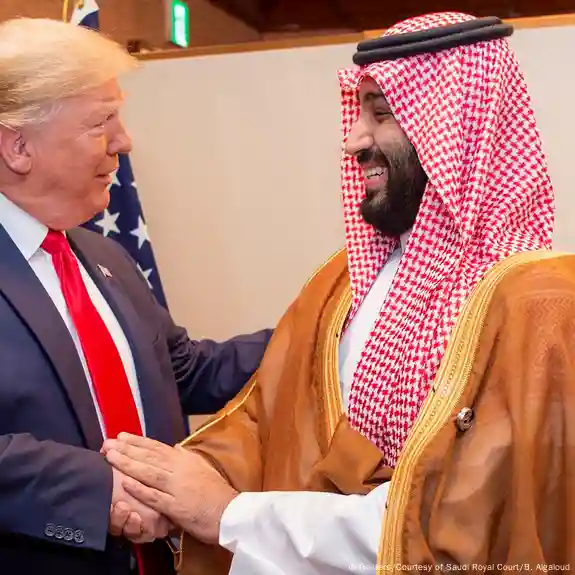
The characteristics of the alliance between the United States and Saudi Arabia are being renewed with the return of Donald Trump to the White House, bringing with him great economic ambitions and controversial political demands. Trump’s recent statements at the World Economic Forum in Davos highlight his vision to boost Saudi investment in the United States, calling for an increase in the size of previously announced investments from $600 billion to $1 trillion, a figure which raises questions about the possibility of achieving him and his hidden objectives.
Economic vision or political game?
Trump is clearly banking on economic relations with Saudi Arabia as part of his strategy to revive the American economy. His call for Saudi Crown Prince Mohammed bin Salman to increase the volume of investments has connotations that go beyond economics, as it links trade and energy issues on the one hand, and political interests on the other. on the other hand, particularly with regard to its role in reducing investments. oil prices and their impact on the Russian-Ukrainian conflict.
Trump has made clear that lower oil prices could help end the war between Russia and Ukraine, hinting at Saudi Arabia’s central role in global energy markets. But he also makes no secret of his vested interest in promoting job opportunities and economic growth in the United States, building on his administration’s previous agreements with Riyadh.
Will Saudi Arabia react?
The Saudi crown prince confirmed during his call with Trump the kingdom’s desire to expand its investments in the United States, but details on how to achieve this remain vague. The announcement of investments worth $600 billion already represents a significant commitment, equivalent to more than half of the Kingdom’s GDP. The question now is: does Saudi Arabia have the resources and vision to meet Trump’s demand to double that figure?
Geopolitical dimensions
Trump’s demands were not limited to the economy, but included clear allusions to the normalization of relations between Saudi Arabia and Israel as a major goal of his foreign policy. Here, additional complexities arise, as the Kingdom faces internal and regional challenges that make making decisions of this magnitude more delicate.
The issue of reducing oil prices conflicts with the priorities of OPEC, which seeks to balance markets and ensure the stability of member states’ oil revenues.
Alliance or pressure?
Relations between Riyadh and Washington during Trump’s first term were marked by unprecedented cooperation, but Trump’s return to the presidency also means the return of American pressure for greater economic and political concessions. Trump’s recent statements may reflect a desire to build a strategic economic partnership, but they also bear the hallmarks of political pressure and economic blackmail that he is accustomed to exercising with his allies.
Whether or not Saudi Arabia responds to Trump’s request, it remains clear that the relationship between the two countries is going through a new phase of negotiations and challenges. Saudi Arabia seeks to strengthen its position as a regional and international economic power, while Trump seeks political and economic gains that will boost his popularity at home. The final decision will depend on the balance of interests and the ability of both parties to achieve their objectives without harming their strategic relationship.