HIBAPRESS – Rabat
The National Union of Journalism, Media, and Communication, under the umbrella of the Moroccan Labour Union, has condemned what it called the "obscene content of the dangerous leaks" that have been circulated by public opinion, relating to a disciplinary session within the temporary committee for managing press and publishing affairs, which, according to them, has "fallen to the lowest level."
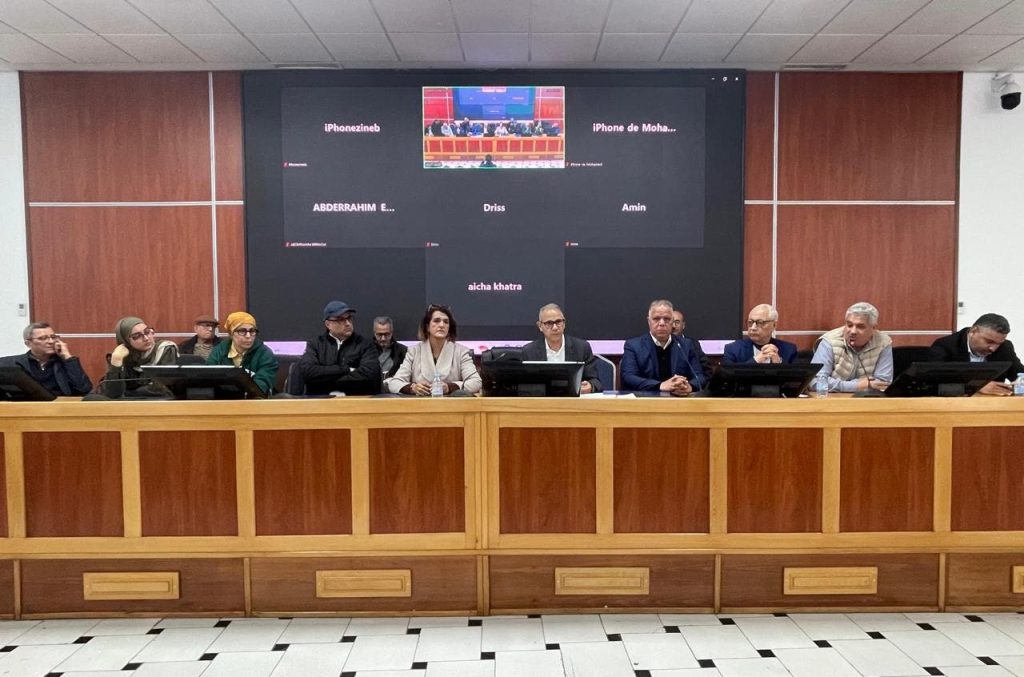
The union said in a statement that it followed, "in an unprecedented moment of shock," the clips attributed to some members of the temporary committee for managing press and publishing affairs, and "what they contained of offensive language, expressions of mockery, and content that undermines the due respect for individuals, the profession, the disciplinary system, and the professional bodies themselves."
The trade union body considered that these clips constituted, "with the explicit vengeful tone they carried, a serious ethical and institutional failure that is unacceptable in any way, and offensive to the image of our media internally and externally," adding that "it became clear to public opinion, and unfortunately, that a session that is supposed to be characterized by wisdom, integrity, and dignity has turned into a space for settling personal scores, and a discourse that does not befit those who are supposed to be 'wise' and who are responsible for deciding on the issues of colleagues."
The same union condemned "the insults contained in the leaked clips to the lawyers who attended to exercise their natural right to support and the mockery of them," highlighting that this matter "expresses a level that does not honor the journalistic body and is not befitting of an institution that is supposed to respect the law and enshrine the basic guarantees of a fair trial, even within the framework of the disciplinary procedure."
The National Union of Journalism, Media, and Communication affirmed that it does not exonerate the journalist Hamid al-Mahdaoui, "from professional errors and holds him responsible in case he commits any professional or legal violation or deviation," but it considers that "his right to a legal, neutral, and independent disciplinary procedure from any other authority is a non-negotiable and non-interpretable right. The disciplinary procedure is not a field for revenge or an arena for settling scores, but rather a legal institution governed by guarantees and the presumption of innocence."
It pointed out that it had previously, "through its memoranda, reports, letters, and statements, warned of the accumulated imbalances within the temporary committee, the individualistic methods of its president, the illegitimate expansion of powers, and even his abuse of the human resources themselves, some of whom were arbitrarily dismissed in front of the government and all bodies, without legal basis and without any oversight or accountability. These leaks were only the naked face of practices that we have drawn attention to over the past years, and new evidence that the continuation of the current situation will lead the profession to further deterioration."
It explained that "what happened today is the natural result of a wrong path that must be acknowledged, starting from the moment of the unjustified extension, passing through the appointment of a temporary committee outside the mechanisms of democracy, and ending with reaching a dangerous level of ethical and institutional slips," noting that it has repeatedly emphasized "that moving away from the democratic path that passes through professional elections will only produce a greater loss of legitimacy, more impulsive decisions, and more damage to the image of the national press."
It stressed that "the press, as the fourth estate, should have remained at an equal distance from the rest of the authorities, not to follow the logic of dominance and loyalties or guidance or subordination, and not to turn into a space that reflects practices that affect the independence of the journalistic body, which forms the backbone of freedom of expression."
At the end of its statement, the National Union of Journalism, Media, and Communication affirmed that "Morocco deserves an independent and honest professional body, and Moroccan journalists deserve institutions that respect their values, not sessions that are managed with the logic of revenge, and not a language that offends justice, camaraderie, and the profession. The entrance to real reform begins with accountability, dialogue, and the restoration of democratic legitimacy, not with patching, justification, or the endorsement of deviations."