HIBAPRESS
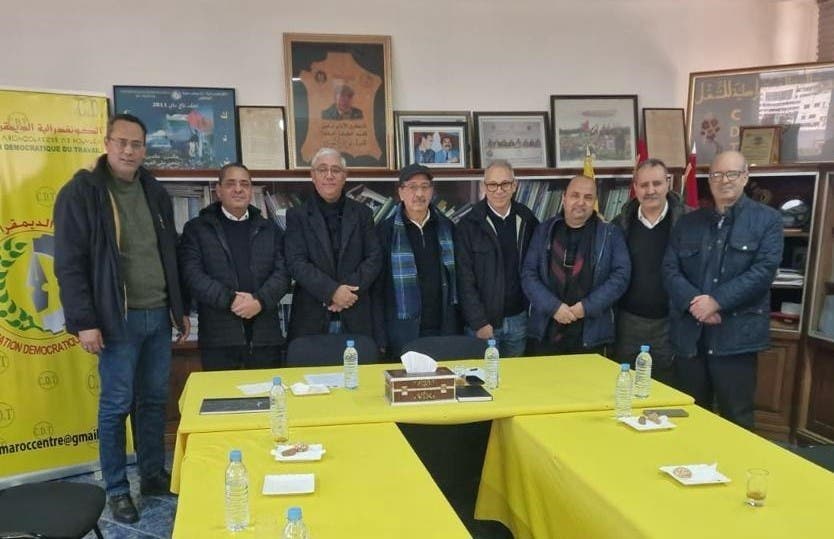
Professional and trade bodies in the press and publishing sector met on Thursday morning, January 8, 2026, with the Executive Office of the Democratic Confederation of Labour, headed by Secretary-General Khlid Houir Elalami, at the organization's headquarters in Casablanca. The meeting was dedicated to discussing developments in draft law 25/26, following its passage by the government based on its numerical majority in the House of Counselors, and the accompanying collective withdrawal of the opposition from the voting session and the submission of a request to the President of the Council to refer the draft to the Constitutional Court, amid warnings of its infringement on self-regulation and freedom of the press.
The professional and trade bodies participating in this meeting included the National Union of Moroccan Journalists, the Moroccan Federation of Newspaper Publishers, the National University of Press, Media, and Communication affiliated with the Moroccan Labour Union, the National Union of Media and Press affiliated with the Democratic Confederation of Labour, in addition to the Moroccan Confederation of Newspaper and Electronic Media Publishers. During the meeting, the professional and trade bodies reviewed the advocacy path they had taken to return the project to the table of responsible and productive social dialogue, leading to a broader consensus among the various stakeholders and providing the legal guarantees associated with the law. This path included the preparation of memoranda, correspondence, and meetings with a number of concerned institutions, with the bodies taking responsibility for drawing attention to what they considered to be constitutional and legal imbalances in the text, which were previously confirmed by advisory opinions issued by the Economic, Social, and Environmental Council and the National Human Rights Council. The professional and trade bodies also reminded, during the meeting, the Secretary-General of the Confederation of the advocacy undertaken by the opposition forces within the two chambers of Parliament, which aimed to contribute to improving the legislative text in a way that serves the public interest and protects the profession as a vital and strategic sector, reiterating their thanks to the leadership of the Confederation for standing alongside the bodies in their battle to defend the institution of self-regulation and all professionals in the press and publishing sector. For his part, the Secretary-General of the Democratic Confederation of Labour, Khlid Houir Elalami, considered that the passage of draft law 25/26 falls within the framework of what he described as legislative tyranny, based on the use of the numerical majority to impose unilateral legal choices, without regard for the principle of social dialogue or for the positions of the trade and professional organizations directly concerned with the content of the text. The trade union official explained that this approach is not limited to the press and publishing sector, but reflects a general trend in dealing with a number of social and professional files, where the logic of negotiation and consensus is circumvented and replaced by imposing a fait accompli, which leads to deepening social resentment and weakening confidence in representative institutions. The Secretary-General of the trade union center stressed that the infringement on the self-regulation of the profession, through imposed legislation lacking professional legitimacy, constitutes a direct blow to the freedom of the press and affects one of the basic pillars of the state of law, stressing that the freedom of the press cannot be guaranteed by punitive laws or detailed structures, but by a democratic will that respects the independence of the profession and the choice of its representatives, warning that ignoring the observations of constitutional institutions, human rights opinions, and not interacting with the proposals of the trade and professional bodies and the parliamentary opposition reflects the seriousness of the legislative path chosen by the government. At the conclusion of the meeting, the Secretary-General confirmed that the Democratic Confederation of Labour considers the battle of the press and publishing sector an integral part of a broader battle to defend rights and freedoms, reiterating the trade union center's commitment to engaging in unity initiatives and supporting the struggles of journalists and publishers, and defending an independent, democratic, and elected self-regulation as a basic condition for safeguarding freedom of expression and professional dignity.