HIBAPRESS – Abdellatif Baraka
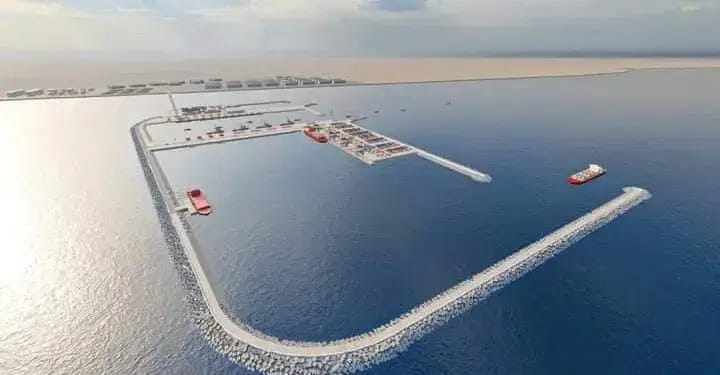
The construction work of the Dakhla Atlantic Port is progressing rapidly, in one of the largest maritime projects witnessed by the south of the Kingdom during the last decade, as the overall completion rate has exceeded the threshold of half "53 percent", amid technical indicators indicating that the project has entered the decisive stage in a number of its major structural components.
The data circulated within the project show that the basic marine structure is almost ready, after nearing the completion of the marine bridge linking the land and the anchorage area, which is a pivotal element in enabling commercial ships and industrial fishing vessels to safely access the port, even in the difficult climatic conditions experienced by the southern Atlantic coasts. Construction work has also begun to install the massive concrete blocks used to reinforce the quays and breakwaters, according to internationally approved engineering standards in major ports. This project is not limited to being a logistical infrastructure only, but it is relied upon as a development engine to reshape the economic system in the Dakhla-Oued Ed-Dahab region, by attracting investments related to industrial fishing, the valorization of marine products, and the development of shipping, storage and port services. It is also expected that the port will create a new dynamic in the local labor market, both during the construction phase and when the facility enters the operational phase. Decision-makers are betting that the port, the "royal project," will turn into a maritime link platform between Morocco and its African depth, especially the countries of the Sahel and West Africa, in the context of a strategic direction to strengthen South-South economic integration, and connect the southern regions to the trans-Atlantic maritime trade networks towards Europe and Latin America. The project is also part of a broader vision to strengthen the Kingdom's logistical presence on the Atlantic coasts, which enhances the competitiveness of the national economy in the fields of export, import and port services. In the medium term, this project is expected to ease the pressure on some northern and central ports, by creating a new crossing point for goods coming from Africa to European markets, and transforming Dakhla into a southern logistical platform with a continental dimension. With the approaching completion of the major works, attention is turning to the readiness of the road system and the logistical connection parallel to the port, so that the desired economic impact is achieved in an integrated manner, and not only within the limits of the pure port structure.