A journey across thousands of kilometers on a truck departing from the largest vegetable markets in Souss, crossing the desert and the El Guerguarat crossing towards Mauritania and Senegal, where Moroccan agricultural products have become part of food security in West African markets.
HIBAPRESS – Ayman Al-Mughaber
A little before dawn, the wholesale market for vegetables and fruits in Inezgane has already begun its long day. In this place that does not sleep except for a few hours, the sounds of heavy truck engines mix with the calls of brokers who move between the stacked boxes as they display prices and make deals in a hurry.
The yellow lights hanging above the narrow corridors reveal a vibrant scene that resembles a huge beehive, where workers move, and a number of them descend from sub-Saharan African countries, quickly between piles of tomatoes, potatoes, onions and citrus fruits. Here, in this market located in the suburbs of Agadir, every night begins a long journey for Moroccan agricultural products that will cut thousands of kilometers before reaching the tables of families in distant cities within the African continent.
Among the rows of refrigerated trucks parked in the shipping yard, Abdul Qader stands, an international transport truck driver who is a little over forty, watching with an expert eye the process of loading his truck, wearing a light cotton hat and carrying in his hand a small list that includes the details of the shipment.
The workers carefully arrange the boxes inside the trailer, leaving calculated distances between the rows to allow cold air to pass and keep the vegetables fresh all the way. Each box bears a familiar mark written in French "Produit du Maroc". For Abdul Qader, this small phrase sums up a long story. It is not just an indication of the country of origin, but a brand that has become known in West African markets.
Abdul Qader says as he watches the workers: "This shipment will go to Dakar," then pauses for a moment as if recalling in his mind the long road that awaits him before adding with a smile: "The trip may take four days or more, depending on the road and borders." For him, this journey is no longer something new, as for years he has been driving his truck through the desert road that connects Morocco with the depths of the African continent. However, every trip still carries something of adventure, because the road is long, the distances are vast, and the desert is not without surprises.
Inezgane market today is one of the most important commercial centers for vegetables and fruits in Morocco, and even in the entire West African region. Here, the products of the fields coming from multiple agricultural areas such as Souss, Gharb, Loukkos and Doukkala meet. With the development of export chains and increasing demand in the African markets, the trucks leaving this market have become carrying an important part of Moroccan agricultural production towards the south.
In this market, activity is not limited to drivers and workers only. Between the narrow alleys of the market, dozens of brokers and traders move who supervise the sale of vegetables and fruits before the export journey begins. Abdul Rahim, one of the senior brokers in the market, stands next to a truck full of boxes of tomatoes coming from Souss farms, saying as he watches the bidding process between the traders that the demand coming from Africa has become an important factor in the daily market movement, "Years ago, the focus was on the European market, but today Africa has also become a very promising market."
Abdul Rahim points out that many traders in Mauritania and Senegal have begun to deal directly with brokers in the Inezgane market, where the quantities and prices are agreed upon before loading the trucks. He adds that some trucks depart almost every day towards the south, especially during the seasons in which agricultural production is abundant.
Data from the Moroccan Ministry of Agriculture indicates that Morocco has become among the most prominent exporters of vegetables and fruits in the world, where the value of Moroccan agricultural exports has exceeded billions of dollars annually in recent years. Tomatoes, citrus fruits, onions and potatoes form an important part of these exports, which are heading to more than sixty countries around the world. Although Europe remains the first destination for Moroccan products, sub-Saharan African markets are witnessing increasing growth in demand for agricultural products coming from Morocco.
Al-Hussein, one of the brokers who has been working in the market for more than twenty years, says that the volume of demand from Africa has increased significantly in recent years, "Moroccan tomatoes, onions and potatoes are in high demand in Mauritania, Senegal and Mali, the quality is known, and the road has become easier than it was in the past."
At approximately six in the morning, the truck is full to the brim. Abdul Qader reviews the documents one last time, the shipment papers, the refrigeration documents, and the border crossing permit. After that, he closes the trailer door tightly, climbs into the cabin, and starts the engine, which emits a deep roar announcing the start of the journey. Slowly, the truck moves out of the Inezgane market, leaving behind the rising market noise, and heading towards the national road that leads south.
Not far from the Inezgane market, the highway begins to gradually move away from the noise of the city. Behind the truck, the lights of Agadir disappear little by little, while long distances of asphalt extend in front of it, leading south. For Abdul Qader, this road does not just mean a move from one point to another, but represents the beginning of a different stage of the journey, a stage in which the real convoy of Moroccan vegetable trucks begins to move every day towards Africa.
In the spacious cabin of the truck, Abdul Qader adjusts the refrigeration unit fixed behind him. This unit is the heart of the whole journey, because it maintains the temperature of the shipment all the way. These tomatoes, which left the Moroccan fields only hours ago, must arrive in Dakar after days with almost the same freshness. Abdul Qader says, pointing to the control panel: "The temperature must remain stable, because any malfunction may spoil part of the cargo."
Along the road to the south, the other trucks begin to appear, some of them carrying boxes of citrus fruits, and others transporting potatoes or onions, but most of the drivers know each other, as this long journey to Africa brings them together in one path that is repeated many times a year.
At a small gas station by the side of the road, Abdul Qader stops for a while. There he meets another driver named Mustafa, who drives a truck loaded with potatoes towards Nouakchott. Mustafa says as he fills the fuel tank: "The demand for Moroccan vegetables in Africa is very high," then adds, pointing to the road extending south: "Almost every week I make this trip." For him, the long distance is no longer an obstacle, because the African markets have become an important part of Moroccan export activity.
In recent years, Morocco's exports of vegetables and fruits have increased significantly. The Kingdom is today among the largest exporters of tomatoes in the world, where annual production exceeds several million tons. An important part of these quantities is heading towards Europe, but the African markets have also become a growing destination for Moroccan exports, especially with the development of the transport infrastructure across the Moroccan desert and the high level of safety that now allows goods to be transported smoothly and safely.
After crossing the city of Guelmim, the natural landscape begins to change clearly. The rocky and sandy hills extend on both sides of the road, and the sky looks more spacious. Here, the desert begins to impose its own pace on the journey. The road is long and straight in most cases, but the desert winds may sometimes make driving more difficult.
Around noon, the truck passes near another convoy of trucks. The drivers wave to each other with light signals from the lights, as if they are exchanging an unspoken greeting between the members of the same profession. Abdul Qader says that this road has created a kind of solidarity between the drivers, because they know that each of them may need the help of the other at any moment.
As the city of Laayoune approaches, fatigue begins to appear a little, but the road is still long, so Abdul Qader decides to stop at a parking lot designated for trucks on the outskirts of the city. Here, dozens of trucks coming from different parts of Morocco gather. Some drivers sleep inside the cabins, while others sit in a small cafe exchanging conversation.
In this small desert cafe, Abdul Qader meets a man named Al-Arabi, who has also been working in international transport for many years. Al-Arabi says as he sips a cup of hot tea: "Twenty years ago, this road was not as crowded as it is today," then adds with a smile: "Now it has become the road to Africa."
As the sun sets, the truck resumes its journey south. The road between Laayoune and Dakhla extends across vast desert areas that sometimes seem endless. The sand gradients its colors between gold and red, while the sky gradually turns into a wide canvas of orange colors.
As night falls, driving becomes more quiet, the road is almost empty, and the stars fill the sky in an amazing way. Inside the cabin, Abdul Qader turns on the radio to listen to a Moroccan music station that accompanies him on the road. He says that the night is the time when he really feels the length of the journey, because the distances seem greater when the sunlight disappears.
Around midnight, the truck approaches Dakhla, the last of the major cities before the border. Here, the convoy stops again to rest. Some drivers prefer to sleep for a few hours before continuing the road, because the last part towards El Guerguarat requires more focus.
With the first rays of dawn, the trucks set off again towards the El Guerguarat crossing. The road here looks more active, because dozens of other trucks are taking the same path. When the crossing finally appears on the horizon, Abdul Qader realizes that the Moroccan part of the journey is nearing its end. He says, pointing to the queue of trucks waiting to cross: "From here, Africa begins."
At the gate of the El Guerguarat crossing, the trucks appear lined up in a long queue that extends for tens of meters, some of them loaded with fish coming from the southern ports, and others carrying building materials or various consumer goods, but among this convoy of heavy vehicles, the Moroccan vegetable trucks remain the most present. Abdul Qader gets out of his cabin carrying the documents file, and heads towards the customs office where the drivers wait their turn to complete the crossing procedures.
In the square next to the crossing, a number of drivers sit on plastic chairs as they exchange conversations, some of them talk about the road in Mauritania, and others discuss the prices of vegetables in the markets of Dakar and Nouakchott. One of the drivers, named Mohamed, says: "In some weeks, prices in Senegal rise significantly, and then the trip becomes more profitable." For these drivers, it is not only about driving a truck across the desert, but about participating in a large commercial movement that connects Morocco with the depths of the African continent.
After the procedures are completed, the truck slowly moves towards the border point. Behind it remains the last part of the Moroccan road, and in front of it extends a long distance of Mauritanian lands. As soon as the border barrier is crossed, the scene changes a little, the road becomes narrower, and the desert looks rougher. However, the movement of trucks continues continuously, because this border crossing has become in recent years one of the most important commercial crossings in the region.
The road to Nouakchott extends across vast desert areas, where small population groups or modest gas stations appear from time to time. At one of these stations, Abdul Qader stops to have a quick meal and drink a cup of Sahrawi-style tea. He sits at a metal table with other drivers who have come from different Moroccan cities, talking about the road, about the checkpoints, and about the African markets that they know very well.
A truck driver named Idris says that he started these trips more than fifteen years ago, "In the beginning, the trip was much more difficult," he explains as he sips a cup of tea, "The road was not of this quality, and the trucks were less numerous." But with the improvement of the infrastructure and the increase in trade, this road has become an essential part of the trade movement between Morocco and the countries of West Africa.
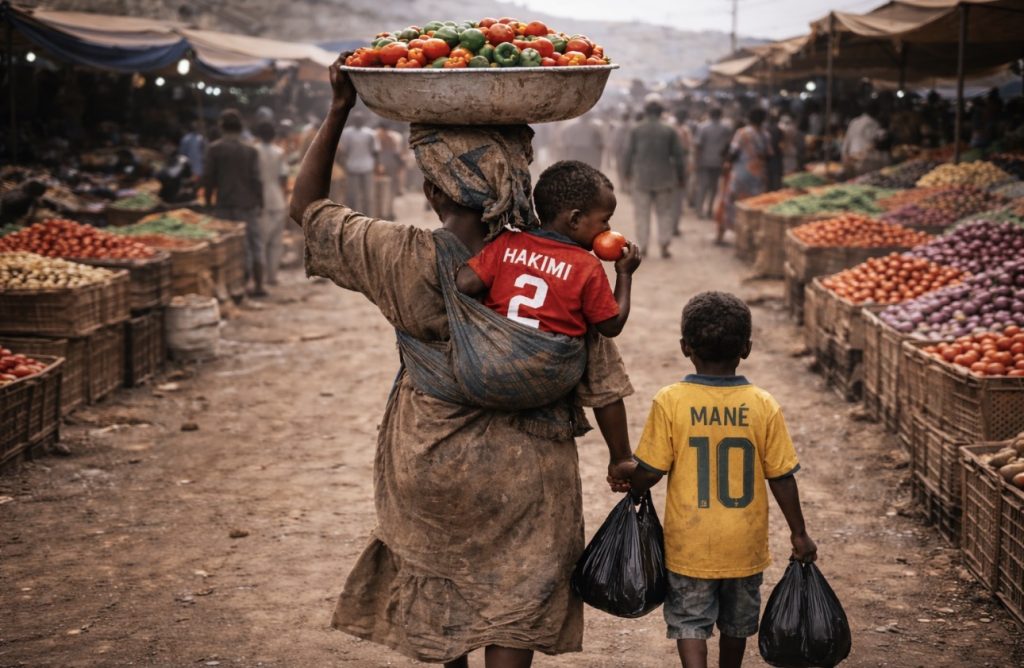
As evening approaches, the lights of Nouakchott appear on the horizon. The Mauritanian capital looks more vibrant than the surrounding desert suggests. Here, some trucks stop to unload part of their cargo before continuing the road to the south. In one of the major markets, a number of traders are waiting for the arrival of trucks coming from Morocco. The boxes of tomatoes and onions carried by these trucks quickly find their way to the sale stalls, where consumers flock to them.
A Mauritanian merchant says that Moroccan products have become an important part of the local market, "The quality is known, and people trust the vegetables coming from Morocco," he explains, pointing to the boxes of tomatoes arranged in front of him. For him, the arrival of these trucks means the availability of fresh goods in the market, which is necessary in a country that depends on imports for part of its food supply.
After a short rest in Nouakchott, Abdul Qader sets off again towards the south. The road to Senegal is longer than it appears on the map. The desert continues to impose its presence, and the villages appear spaced out along the road, but the movement of trucks remains active, because this path forms an essential link in the regional trade network.
As night falls, the journey turns into a completely different experience. The road seems like a black tape that extends endlessly under a sky full of stars. At such moments, Abdul Qader says that he feels the size of the distance that separates Morocco from the final destination of the shipment, "The desert at night is very quiet," he says as he focuses his eyes on the road in front of him, "But you have to stay vigilant all the time."
Inside the cabin, he constantly monitors the screen of the refrigeration unit. Maintaining the appropriate temperature inside the trailer is crucial to the success of the journey. These tomatoes, which left the Inezgane market two days ago, must arrive in Dakar in the best possible condition. Any malfunction in the refrigeration system may lead to significant losses.
With the dawn of the next day, the features of the Senegalese border begin to appear. The road here becomes more crowded, and small cars and transport buses appear on the sides of the road. After completing the border procedures, the Moroccan truck enters the Senegalese territory, to begin the last stage of the journey.
The road to Dakar passes through small villages and scattered agricultural fields. On the sides of the road, the local markets appear where the vendors display their products. Some of these markets are waiting for the arrival of Moroccan trucks carrying fresh vegetables. For many traders, the arrival of these trucks means the beginning of an active trading day.
In the suburbs of Dakar, Abdul Qader finally stops at a large market dedicated to the distribution of vegetables and fruits. The workers open the trailer door and begin to lower the boxes one by one. After a long journey through the desert, the shipment coming from Inezgane arrives at its final destination.
Abdul Qader stands for a while watching the unloading process. For him, this scene represents the end of a journey and the beginning of another, because the trucks carrying the phrase "Produit du Maroc" will not stop traveling through the desert. Almost every day, new trucks depart from the markets of Morocco towards Africa, carrying with them part of Moroccan agricultural production.
In a world where there is more talk about food security and regional cooperation, these trucks seem to be more than just means of transport, they are real economic bridges that connect the Moroccan fields and the African markets, and through these bridges, Morocco is increasingly contributing to securing part of the needs of the African markets for vegetables and fruits.
And so the journey continues, not only the journey of Abdul Qader and his truck, but the journey of thousands of tons of agricultural products that leave the Moroccan lands every day in the direction of the south, in a green march that extends through the desert towards the heart of the African continent.
In the large Dakar market, where Abdul Qader's journey ends, the Moroccan vegetables seem to be a familiar part of the daily offering. In one of the stalls, a Senegalese merchant named Mamadou stands and arranges boxes of tomatoes coming from Morocco. He says that the customers know the source of these vegetables very well, and adds with a smile: "When the Moroccan trucks arrive, we know that the market will witness a large movement."
Mamadou points out that Moroccan tomatoes are characterized by their size and quality, which makes them in demand in the local market, and their rapid arrival through the land route allows them to be sold while they are still fresh, and confirms that many traders in Dakar rely on these shipments to supply the local markets.
And in another market near the port, a number of workers are working on transferring vegetable boxes from trucks to warehouses. One of these workers says that the arrival of Moroccan trucks means a busy day of work, "When the trucks arrive, the work begins immediately, because the traders want to distribute the vegetables quickly to the markets."
For Abdul Qader, the journey ends here temporarily. After unloading the shipment, he prepares to start the return journey to Morocco. The same road awaits him again. However, he knows that his next trip will not be delayed for long. Almost every week, he sets off on a new journey carrying Moroccan vegetables towards the south.
Before leaving the market, Abdul Qader stands for a moment near his truck and looks at the empty boxes that were, a few days ago, filled with vegetables coming from the Moroccan fields. He says with a smile: "When you see these vegetables in the African markets, you feel that the long road was worth the trouble."
And so the journey continues, which begins in markets like Inezgane, and crosses the desert for thousands of kilometers, before reaching West African cities, a journey that carries with it more than just agricultural goods, but a story of growing economic cooperation between Morocco and its African depth, where vegetable trucks turn into bridges connecting the Moroccan land and the markets of the continent.