HIBAPRESS – Muhammad Al-Ashouri
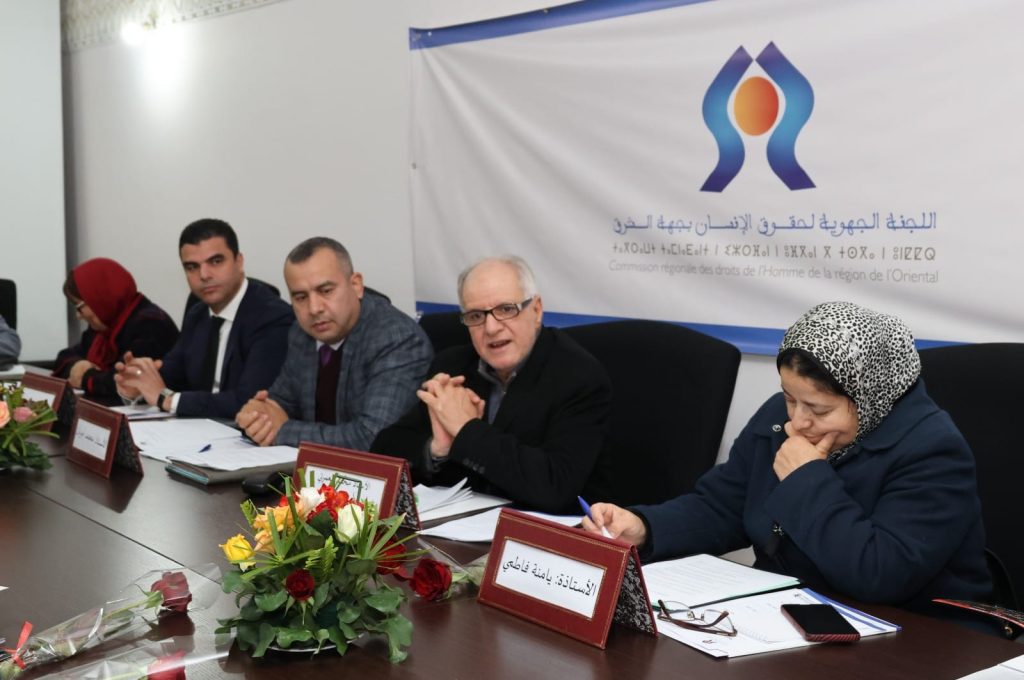
Participants in a meeting organized by the Regional Human Rights Committee of the Oriental region on Thursday, March 12, in Oujda, discussed the topic "Fair Justice: Paths towards empowering women and girls to access justice," within the framework of celebrating International Women's Day and opening a broad discussion about ways to enhance women's and girls' access to justice in a fair and effective manner.
They affirmed during this meeting that achieving fair justice for women and girls remains contingent upon the combined efforts of institutional and civil society organizations in order to dismantle the various legal, institutional, and social obstacles that still limit women's access to justice and their full enjoyment of the guarantees provided by the law.
The speakers at this meeting considered that discussing the topic of fair justice falls within the context of a national dynamic led by the National Human Rights Council, aiming to strengthen institutional advocacy and propose recommendations and practical reforms that would enhance justice guarantees for women and girls through the organization of a national meeting and regional meetings in various regions of the Kingdom.
This discussion comes in light of international data indicating the persistence of the gap between men and women in accessing justice, as UN data indicates that women enjoy only 64 percent of legal rights worldwide, including areas of work, financial resources, safety, family, property, freedom of movement, and business practice.
This meeting also falls within the framework of the National Human Rights Council's attention to the issue of women and girls' access to justice, as it has consistently emphasized in its annual and thematic reports since 2019, as well as through monitoring public policies and field observations, the need to adopt a comprehensive approach that enhances this access and ensures its effectiveness.
The president of the Regional Human Rights Committee of the Oriental region, Muhammad Al-Omarti, confirmed that the celebration of International Women's Day is a renewed opportunity to reflect on ways to enhance women's rights, highlighting that the National Human Rights Council, as a constitutional institution concerned with defending and promoting human rights, is keen every year to celebrate this occasion by organizing national and regional meetings.
He added that the Regional Human Rights Committee of the Oriental region has also been involved in this dynamic by organizing this meeting, which aims to open a broad discussion about women and girls' access to justice, with the participation of representatives from civil society and community activists, along with representatives from the justice sector.
Professor Al-Omarti pointed out that these obstacles are not limited to legal or procedural aspects only, but also extend to social and cultural dimensions that perpetuate discrimination and reproduce the exclusion of women and girls, which may in some cases lead many of them to refrain from reporting cases of violence or various violations they may be subjected to.
In his turn, the Vice-President of the Primary Court of Oujda, Ali Ahnin, reviewed in his intervention, titled "Judicial Procedures between the Limitations of Women's Justice and Ways to Overcome Obstacles to Accessing Justice," through an approach that combined sound academic analysis and daily field experience, a set of problems related to the extent to which judicial procedures can ensure effective justice for women, highlighting that the discussion about access to justice is inseparable from understanding the legal and social contexts within which female litigants operate.
Mr. Ahnin, who holds the position of visiting professor at the Faculty of Legal, Economic and Social Sciences in Oujda, explained that judicial practice often reveals real difficulties faced by women during the litigation process, whether at the procedural level or in terms of the social and economic constraints that may hinder their access to their rights.
He also affirmed that overcoming these obstacles is achieved through the development of legal support mechanisms and the promotion of rights awareness, in addition to simplifying procedures and consolidating approaches that are more sensitive to gender within the justice system, in order to ensure fair and effective justice for women, pointing out the importance of judges adopting what can be called "judicial emotional intelligence," through understanding the human context of the cases presented to them without departing from judicial impartiality.
For her part, the lawyer and parliamentarian for the Oriental region and a member of the Justice, Legislation and Human Rights Committee in the House of Representatives, Houria Didi, explained that her participation in this meeting falls within the framework of an intervention that addressed the topic of the national legislative framework between the achievements made and the continuation of the actual equality gap in practical reality.
She added that Morocco has accumulated in recent years a set of legislations that enhance women's rights, in addition to its ratification of a number of international conventions related to human rights, which reflects the Kingdom's commitment to consolidating the principle of equality and ensuring the political, economic, social, cultural and environmental rights of women.
She also affirmed that these achievements, despite their importance, have not yet reached the level of achieving the desired actual equality, stressing the need to strengthen the presence of women within decision-making centers and continue to develop public policies in a way that takes into account their impact on women, with a view to achieving comprehensive development in which women are at the heart of the development process and a key focus in building a balanced society.
For her part, Yamna Fatmi, a professor of higher education at the Faculty of Legal, Economic and Social Sciences in Oujda and a community activist in the field of family mediation, considered that achieving fair justice remains contingent upon overcoming a set of structural, social and cultural obstacles that still affect the access of a number of groups, especially women, to their full rights, and explained that these obstacles are manifested in the persistence of some social and cultural representations that limit women's awareness of their rights, in addition to constraints related to economic vulnerability and weak access to legal information and support services.
The speaker highlighted that strengthening the path of fair justice requires working on developing legal and social empowerment mechanisms, by strengthening legal advice and support services, intensifying awareness and rights awareness programs, as well as supporting family mediation mechanisms as an effective entry point for managing disputes in a consensual manner that preserves the dignity of the parties and ensures family stability.
She also stressed the importance of combining the efforts of various institutional and civil society actors in order to consolidate a culture of equality and fairness within society, and to work on adapting public policies with a gender approach, in a way that ensures enhanced women's access to justice and achieving more effective legal and social protection.