HIBAPRESS – Fikri WalidAli
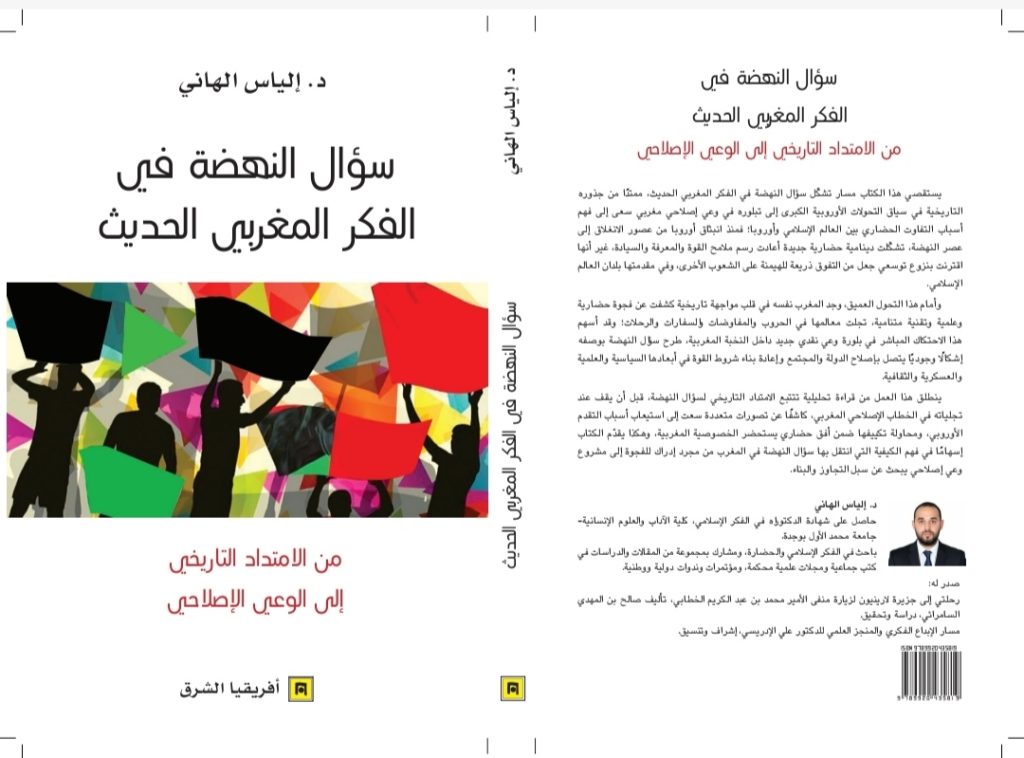
Researcher Dr. Elias Al-Hani is preparing to release a new scientific book that addresses the path of the formation of the question of the Renaissance in modern Moroccan thought, in an intellectual and analytical work that seeks to read the historical and intellectual transformations that accompanied the emergence of reformist consciousness in Morocco, and an attempt to understand the civilizational backgrounds that prompted the Moroccan elite to think about ways of advancement and renewal.
This book comes in the context of the growing interest in intellectual and civilizational studies that reread the modern Moroccan experience, as the author explores the roots of the question of the Renaissance since the major European transformations that the European continent witnessed with the beginning of its exit from the Dark Ages, and its transition to the Renaissance, which is the stage that constituted a deep turning point in the history of humanity, as it reshaped the concepts of power, knowledge, and sovereignty, and produced a new civilizational dynamic that contributed to Europe's progress scientifically, technically, and militarily.
However, this European Renaissance, as the book clarifies, was not merely a cognitive and cultural transformation, but was also associated with an expansionist tendency based on scientific and technical superiority, and turned into a project of hegemony and control over other peoples, foremost of which were the countries of the Islamic world, and Morocco was among the countries that found itself in direct confrontation with these transformations, which revealed a growing civilizational gap between Morocco and Europe, the effects of which were reflected in various political, military, economic, and cultural fields.
The book highlights that this historical confrontation was not just a military or political clash, but was also a moment of deep civilizational awareness, which prompted the Moroccan elite to think about the reasons for European superiority, and to seek to understand the factors of progress that contributed to building European power. This confrontation was manifested through a number of historical stations, such as the wars that Morocco fought with the European powers, the political negotiations, and the diplomatic embassies, in addition to the travels of Moroccan scholars and envoys to Europe, which contributed to conveying a direct picture of the manifestations of European progress.
In this context, the book emphasizes that the direct contact between Morocco and Europe contributed to the crystallization of a new critical awareness among the Moroccan elite, where the question of the Renaissance began to be raised as an existential problem related to the future of the state and society, and to rebuilding the conditions of civilizational power. This reformist consciousness revolved around a number of fundamental issues, including state reform, modernization of institutions, development of education, building military strength, and enhancing scientific knowledge, in addition to preserving the cultural and religious identity of Moroccan society.
The work starts from an analytical reading that traces the historical extension of the question of the Renaissance, before it stops at its manifestations in the Moroccan reformist discourse, where it reveals the multiplicity of perceptions presented by Moroccan thinkers and scholars in their attempt to understand the reasons for European progress, and also discusses how to adapt these perceptions within a civilizational horizon that evokes Moroccan specificity, and balances between the requirements of modernization and the preservation of cultural and religious constants.
The book also provides an important contribution to understanding how the question of the Renaissance in Morocco moved from a mere realization of the civilizational gap to a reformist consciousness project that seeks to transcend and build, as the question is no longer only related to understanding the reasons for backwardness, but has become related to producing a civilizational project that seeks to build a new future based on knowledge, values, and civilizational effectiveness.
This new release comes within the research interests of Dr. Elias Al-Hani, which focuses on issues of Islamic thought, civilizational renewal, and the analysis of reformist discourse in the Islamic world, especially in the Moroccan context. This book is considered a qualitative addition to the Moroccan intellectual library, because it includes a deep analytical reading that combines the historical, intellectual, and civilizational dimensions.
It is worth mentioning that Dr. Elias Al-Hani holds a PhD in Islamic Thought from Mohammed I University in Oujda, and he is a researcher in Islamic thought and civilization, and he has multiple scientific contributions in collective books and peer-reviewed scientific journals, in addition to his scientific presence in a number of international and national conferences and seminars, where he is interested in studying issues of the Renaissance, intellectual reform, and contemporary civilizational transformations. This book is expected to be published soon, to be available in libraries, and to form an important reference for researchers and those interested in modern Moroccan thought and the issues of the Renaissance and civilizational renewal.