

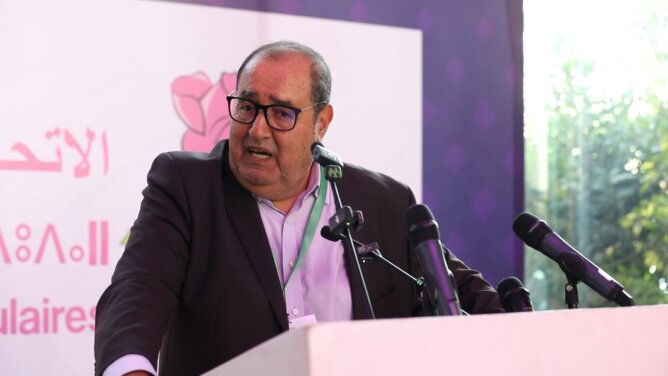
Idris Lashkar, the First Secretary of the Socialist Union of Popular Forces Party, finds himself at one of the most sensitive junctures of his political career, with the commencement of consultations for the formation of the next government, led by Fatima Ezzahra El Mansouri of the Authenticity and Modernity Party. Following the party's National Council's vote to manage consultations for government participation, the question is no longer limited to the Socialist Union's entry into the majority, but has extended to the nature of the conditions Lashkar will set, the extent of the gains he will demand, and his ability to maintain the independence of party decisions within a coalition governed by multiple calculations.
To understand Lashkar's choices, one must recall his track record in managing political battles, from the debate over the electoral threshold to the motion of censure, including his clashes with opponents within the party landscape. The man has accumulated experience that makes him realize that government negotiations are not always decided by the number of seats, but also by the ability to impose political conditions and secure positions that give the party actual influence in decision-making.
From this perspective, the issue of ministerial portfolios appears to be part of a broader equation concerning the Socialist Union's position within the upcoming majority, and whether it will secure substantial participation or settle for a limited presence that does not align with its ambitions.
However, Lashkar's path is not paved with gains, as he faces criticism from political opponents, particularly from the Justice and Development Party, as well as questions raised by a segment of public opinion about the Socialist Union's place within the Moroccan left. Furthermore, the distancing from the Progress and Socialism Party and disagreements with other leftist components have made the task of regaining a unifying unionist role more complex. Therefore, governmental rapprochement with the Authenticity and Modernity Party will not merely be an alliance to manage the current phase, but will require Lashkar to clarify the political basis for this choice and how to reconcile government participation with the party's historical reference.
In this context, the question of the speakership of Parliament and significant governmental positions emerges as files that may be considered in negotiation calculations, without this meaning confirmed demands regarding them. Will Lashkar accept limited portfolios in exchange for influence in the government program, or will he insist on a representation that gives his party greater political weight? What is certain is that the man understands that entering the government without clear guarantees could turn participation into a burden, especially if the party finds itself obligated to defend decisions in whose formulation it lacks sufficient influence.
The importance of these calculations increases as a new phase in managing party leadership approaches, as the outcome of the negotiations could become part of the assessment of Lashkar's tenure at the head of the Socialist Union.
The man is required, in the final stages of his management of the veteran party, to prove that his political experience is capable of returning the party to a position of initiative, rather than merely securing a presence within institutions. He may choose a difficult path that links participation to a clear political and programmatic contract, instead of just distributing portfolios. However, he risks bearing the cost of entering a majority that will face significant social and economic expectations.
Ultimately, Lashkar's test is not solely about the number of unionist ministers in the next government, nor about the positions the party may obtain, but about his ability to transform potential participation into a sustainable political gain. Opposition is not necessarily defeat, just as entering government does not automatically mean victory. Between the ambition to regain the historical status of the Socialist Union and the risks of integration into a coalition led by other forces, Lashkar's decision will reveal the nature of his final gamble: is he seeking to rebuild his party's influence from within the government, or does he prefer to maneuver from outside to preserve a greater margin of independence?