HIBAPRESS – Rabat
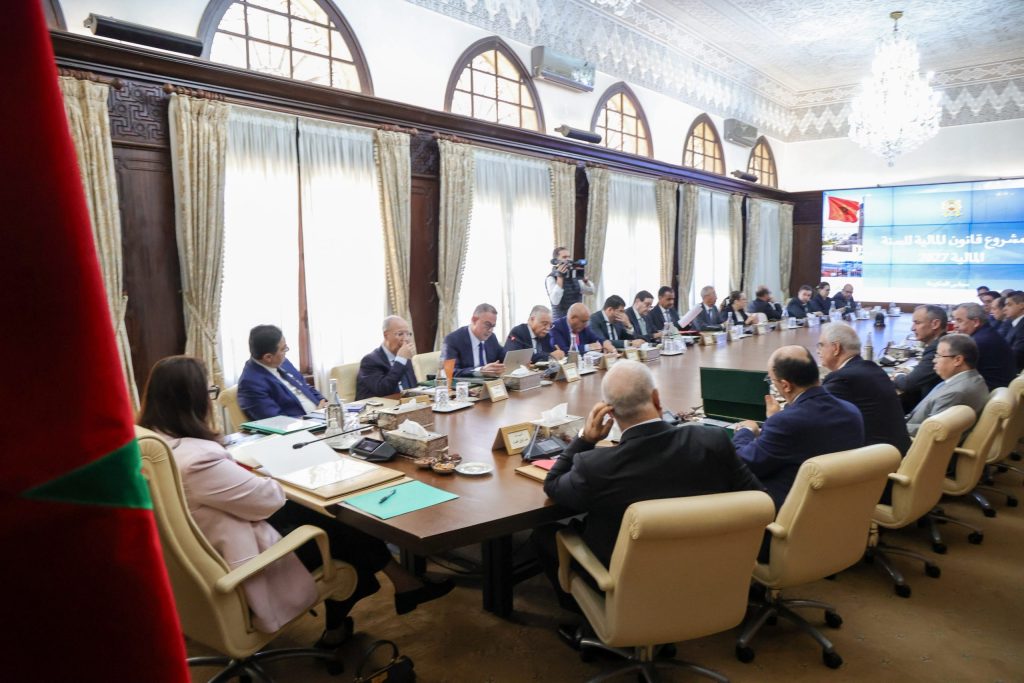
The Government Council, meeting today Tuesday, chaired by Fatima Zahra Mansouri, the Head of Government, approved the draft finance law No. 60.26 for the fiscal year 2027.
A statement from the Minister of National Territory Planning, Urbanism, Housing, and City Policy, and Government Spokesperson, Samir Amiri, indicated that during this meeting, the draft law, presented by Fouzi Lekjaa, Minister of Economy and Finance and Public Administration Reform, was discussed and approved.
Minister of Economy and Finance and Public Administration Reform, Fouzi Lekjaa, had previously presented an overview of the draft finance law for 2027 to King Mohammed VI.
The draft finance law for the fiscal year 2027 focuses on the following five priorities:
– First: Restoring purchasing power and consolidating the foundations of a sustainable social state: Starting from 2027, structural reforms to markets and prices will be implemented, along with a set of measures aimed at supporting citizens' purchasing power, continuing the generalization of health coverage and ensuring its sustainability, increasing direct social assistance, and doubling efforts to rehabilitate the public health and education systems and enhance access to decent housing through the implementation of the direct housing support program.
– Second: Integrating youth into education, training, and decent employment: The government will launch an integrated national youth program for 2027-2031, based on guiding them towards training programs, professional support, and facilitating access to financing, guarantees, and markets.
– Third: Accelerating the implementation of advanced regionalization and a new generation of integrated territorial development programs: This is in line with the High Royal Directives concerning the re-engineering of regional competencies with clarity and efficiency, strengthening coordination and contracting mechanisms between the state and the regions, and the full implementation of the administrative deconcentration charter.
– Fourth: Strengthening strategic water, energy, food, and digital sovereignty: This ensures strategic water security, accelerates the renewable energy development program, continues the implementation of Morocco's green hydrogen offering, and the gradual implementation of the gas infrastructure roadmap, alongside measures to ensure food security and strengthen national digital sovereignty.
– Fifth: Building a strong economy capable of financing social and sovereign ambitions, while accelerating the implementation of institutional reforms and ensuring the stability of macroeconomic and financial balances: This aims to provide the necessary funding to accelerate the dynamics of major development projects and sectoral strategies in various fields, while working to develop new sovereign industrial systems.
The draft finance law for 2027 gives special attention to strengthening private investment by consolidating the support mechanisms stipulated in the Investment Charter and continuing the reform of Regional Investment Centers, with a focus on supporting micro, small, and medium-sized enterprises.
The draft finance law for 2027 places particular importance on youth concerns, which constitute the most significant and urgent issues of the current phase. This necessitates a shift from fragmented sectoral programs that have proven limited to an integrated national policy to track youth from education and training to employment and housing, ensuring their economic and social stability.
In implementation of the High Royal Directives, the new generation of integrated territorial development programs will be accelerated by allocating financial credits estimated at 25 billion dirhams.