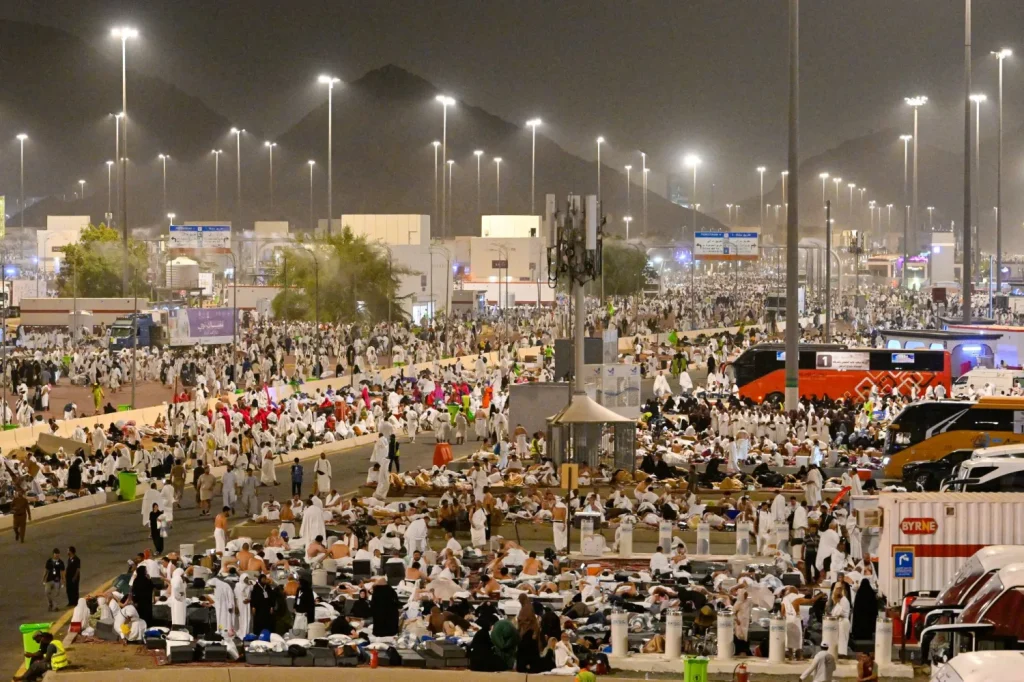
Pilgrims to the Sacred House of God settled on Tuesday evening in Muzdalifah after departing from the plains of Arafat following the performance of the greatest pillar of the Hajj rituals, in an atmosphere of faith characterized by tranquility and reverence, amidst a well-organized and smooth movement between the holy sites.
Upon their arrival in Muzdalifah, the guests of Rahman performed the Maghrib and Isha prayers, combining and shortening them, following the Sunnah of the Prophet Muhammad, peace be upon him. Then, they began collecting pebbles for the Jamarat in preparation for moving to the next stage of the rituals. It is expected that the pilgrims will head to Mina after spending the night in Muzdalifah on the tenth of Dhu al-Hijjah, after the Fajr prayer on Wednesday, which corresponds to Eid al-Adha, where they will stone the Jamarat al-Aqaba al-Kubra and slaughter the sacrificial animals, then shave or shorten their hair, signaling the beginning of the release from Ihram. The departure from Arafat to Muzdalifah is the third stage in the sequence of the pilgrims' movements within the holy sites. This year, it was distinguished by remarkable smoothness thanks to the intensive organizational efforts undertaken by the competent authorities to ensure the safety of the guests of Rahman and facilitate their movement. Muzdalifah holds special religious significance, as it is one of the sites in which God Almighty commanded that He be remembered. It is located between Arafat and Mina, at a distance of approximately eight kilometers from the Grand Mosque, and extends over an area exceeding 11.68 million square meters, with a capacity exceeding two million pilgrims. The site is also distinguished by being an open space without permanent buildings, in order to preserve its legal and organizational character. It includes in its center the "Al-Mash'ar al-Haram," which witnesses the gathering of pilgrims for remembrance, supplication, and supplication to God Almighty. As part of the development of services, the site witnessed qualitative projects to rehabilitate the infrastructure and improve the pilgrims' experience, including the "Mashaaer Path" project, which was supervised by the Kudana Company. Wide areas were prepared with rubber floors and paths designated for pedestrians and vehicles, in addition to equipping multiple service facilities that include water, seating areas, mist columns, phone charging, and umbrellas. The Ministry of Islamic Affairs also worked on preparing the Al-Mash'ar al-Haram Mosque through integrated operational plans that included air conditioning, lighting, loudspeakers, and expanding the capacity, ensuring smooth movement and the quality of services provided to worshipers. The organization of crowd movement between the sites relies on advanced digital systems and central control rooms that allow for real-time monitoring and rapid intervention when needed, enhancing the security and safety of pilgrims during their movements. In its entirety, Muzdalifah embodies an integrated model of organization and services, and reflects the extent of care that the Kingdom of Saudi Arabia gives to the guests of Rahman, ensuring the performance of the rituals in an atmosphere of security, tranquility, and ease.