This article was automatically translated from HIBAPRESS, the Arabic version:
This article was automatically translated from HIBAPRESS, the Arabic version:
Heba Press – Abdel Latif Baraka
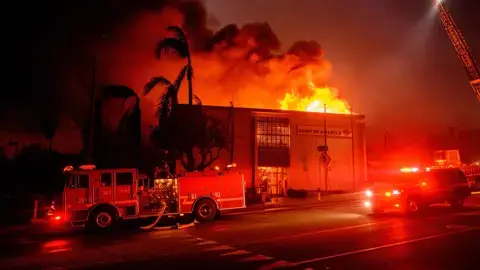
The wildfires ravaging Los Angeles and other parts of California constitute one of the largest natural disasters threatening the United States of America and have therefore become a hotbed of political division between Democrats and Republicans.
As Republican President-elect Donald Trump is set to be sworn in for a second presidential term, controversy is intensifying over how to deal with these disasters and the possible causes of them.
This conflict is clearly evident between California Governor Gavin Newsom and the next President of the United States, Donald Trump, as it reflects their differences over environmental and administrative policies that raise questions about the near future of the United States during Trump’s second term. term.
Disagreements between Democrats and Republicans:
1. Interpretation of the causes of fires:
As the fires rage in California, Democrats and Republicans are offering very different explanations for their causes. For Democrats, led by California Governor Gavin Newsom, these fires are the obvious result of global climate change, which they see as an ongoing threat that calls for sweeping changes in environmental policies. Newsom himself suggested that the unprecedented severity of the fires was due to high winds and persistent drought, which he said is proof that climate change has become a reality that cannot be ignored.
As for Republicans, including Trump, they believed that these fires were caused by poor management on the part of local and state officials, believing that there had been negligence in the management of forests and in their cleaning of dry and flammable grasses. . Trump, for example, directly blamed California Governor Newsom, calling him “Newscom,” reflecting his distrust of fire management policies under his watch.
2. Politicization of tragedy:
There is increasing politicization around this natural disaster. At a time when politicians were expected to unite in the face of crisis, deep disagreements arose between Democrats and Republicans. While Newsom called on Trump to visit fire zones to survey the damage and interact with those affected, Newsom returned by describing some of the statements Trump made about water retention as “false,” in reference to the claims of the president-elect that water is being withheld from Southern California for environmental purposes. These statements have drawn mixed reactions, with some seeing them as an attempt to cast smoke and politicize the tragedy.
3. Trump accused of misleading information:
Along with the politicization of the incident, the issue of misinformation spread by Trump regarding environmental policies in California has emerged. In public statements, Trump has claimed that the state’s environmental policies are responsible for water shortages in the region, with water being allocated to protecting fish species rather than fighting fires. But reality reveals that most of Los Angeles’ water comes from the Colorado River and is primarily used in the agricultural sector. This manipulation of facts increased tensions between political factions and led to an even greater division between the mass bases of the two parties.
4. Divergent positions on the federal response:
Although Newsom, considered one of the most prominent Democratic figures in the country, has expressed his willingness to cooperate with Trump, doubts about the latter’s intention to provide federal aid to the state are growing among local officials in California. Newsom noted that fears that Trump might refuse this aid seem “reasonable,” reflecting a state of distrust between the two parties.
5. Political benefit of the disaster:
On major policy issues, Republicans like Trump use fire to criticize the Democratic administration’s policies. As Trump moves closer to regaining power, this type of political attack on Democrats is likely to continue on multiple issues, including environmental and governance policies. On the other hand, Democrats seek to exploit these crises to emphasize the importance of their environmental policies in the fight against climate change.
Today and in the near future:
As the conflict between the two sides continues amid natural disasters, the situation in California shows signs of evolving into more political tension, especially as Trump nears the start of his second term. This could lead to an escalation of conflict between Democratic-controlled states and the Republican-led federal government. At the same time, California’s fire crisis is expected to be part of the broader political debate over the future of environmental policies in the United States, which could be a major topic in the next presidential election.
The California fires are a perfect example of how natural disasters are politicized in American politics, with each party using these events to validate their policy positions. As Trump approaches a second presidential term, these differences will continue to constitute a political battleground that could have a significant impact on U.S. domestic and foreign policy in the near future.