HIBAPRESS
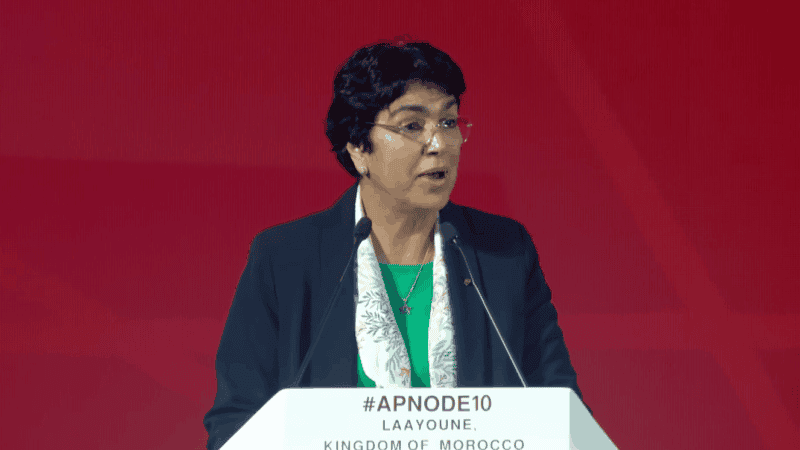
The First President of the Supreme Audit Council, Zineb Al-Adawi, confirmed today, Friday in Laayoune, that the field of cooperation between the Supreme Audit Council and the legislative authority has witnessed tangible development, especially after the adoption of the Kingdom's constitution in 2011, which made the principle of cooperation between the authorities one of the cornerstones of the constitutional system.
Al-Adawi highlighted, in a speech on the occasion of the launch of the work of the tenth annual general assembly of the African Parliamentarians Network for Development Evaluation, that the amendment of the law regulating the council in 2016 formed a qualitative leap in strengthening the cooperative relations between the Council and Parliament, and in defining and controlling the scope of this cooperation, as it became more extensive and diverse and its bridges extend throughout the year and are no longer occasional as they were before.
In this context, Al-Adawi mentioned that the Council has received, since 2013, a total of 14 requests for consultation and questions from Parliament, regarding which answers have been provided, related to various topics and fields such as the compensation system, the pension system, the Social Cohesion Support Fund, the Collective Equipment Fund, and the Rural Development Fund, in addition to issues concerning youth employment programs and education in the rural world, the national strategy to combat illiteracy, and the program to reduce spatial and social disparities in the rural world.
She continued that the Council is constantly keen to establish effective cooperation mechanisms in order to ensure the integration of the supervisory roles of the two institutions and to safeguard their reputational position and preserve the assets of their credibility, objectivity, trust, and professional competence.
On another level, Al-Adawi pointed to the multiplicity of mechanisms for the Council's dealings with Parliament, which include presenting the results of supervisory work within the framework of the annual report, which is published in the Official Gazette, and presenting the First President a presentation on the work of the Supreme Audit Council before Parliament, as well as a report on the implementation of the Finance Law and the general declaration of conformity related to the Liquidation Law.
On the other hand, and in view of the low level of achieving the goals of the 2030 agenda, the same official stressed the need to evaluate the outcome of the supervisory and evaluation work of the African continent, during the period 2015-2025, and to draw lessons and represent the horizon of "Roadmap 2063 for Economic and Social Transformation in Africa" and "The Decennial Plan 2024-2033", according to new visions, positions, and methodologies for approaching the evaluation of development policies and how to raise its added value in the path of public decision-making.
Regarding developments and prospects for the work of the supreme audit institutions on development issues, Al-Adawi highlighted that the majority of these institutions have included in their strategic plans goals related to addressing development issues with various audit, control, and evaluation activities in this field, citing the evaluation of governments' readiness to implement the 2030 agenda, and the evaluation of coordination mechanisms and monitoring and disclosure systems, and the evaluation of government policies and programs related to many of the goals and objectives of sustainable development.
In a related context, Al-Adawi pointed out that the choice of the topic "Evaluation as a collective responsibility and a democratic lever for comprehensive and transparent governance", falls within a global and continental context characterized by radical transformations and rapid technological developments, and in the midst of complex and interrelated financial and economic, and sometimes environmental and security, challenges that cast a shadow on the achievement of sustainable development agendas.