HIBAPRESS
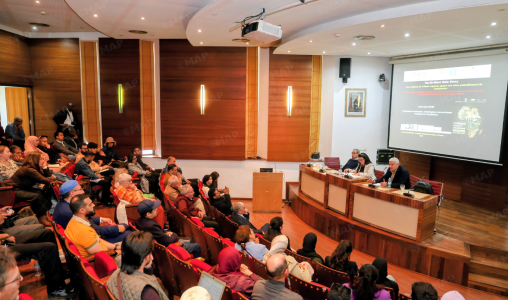
The "Iklil Rabat" Cultural Center, affiliated with the Mohammed VI Foundation for the Promotion of Social Works for Education and Training, organized a scientific and cultural seminar in Rabat today, Friday, under the title "Africa as told by Archaeology," with the participation of a selection of researchers and experts.
This event, organized in partnership with the National Institute of Archaeological Sciences and Heritage, within the framework of valuing the African archaeological heritage, as a cornerstone for understanding the history of humanity and the development of civilizations, aims to open a scientific debate on the concepts of authenticity and sustainability, while taking into account the cultural and geographical specificities of the continent's regions. The seminar also seeks to identify actors in the field of heritage protection and shed light on the challenges facing its preservation, especially in light of armed conflicts, illegal trafficking in cultural property, climate change, and uncontrolled urban expansion. In an intervention on the occasion, the archaeologist participating in the National Institute of Archaeological Sciences and Heritage, Abd al-Rahim Muhibb, said that the choice of the seminar's topic aims to emphasize the pivotal role of the African continent as an essential geographical area in writing the history of humanity in its various cultural, biological, and geological dimensions. Muhibb explained that recent discoveries in Morocco, especially the remains of human bones dating back 315,000 years, have restored consideration to North Africa as a key link in understanding the movements of ancient humans across the continent to the Mediterranean basin. In this context, he stressed that encouraging archaeological research "gives us the necessary material data to complete the historical narrative of humans in general, and not only the African or Moroccan human." For his part, the head of the Museums Department at the National Museums Foundation, Abd al-Aziz al-Idrisi, highlighted the strategic dimensions of continental cooperation in this field, pointing to the importance of Morocco's African facade. He added that Morocco formed a vital passage for human groups in prehistoric times towards the Mediterranean basin, stressing that these migrations were not limited to the transfer of individuals only, but carried with them ideas and knowledge that contributed to enriching cultural interaction. Al-Idrisi emphasized that this ancient heritage has made Morocco a distinguished space for archaeological research, given the antiquity and diversity of the discoveries it possesses. It is worth noting that the remaining scientific interventions during this seminar were characterized by precise and in-depth discussions, which mainly focused on highlighting the universal value of African archaeology, as well as shedding light on the contribution of archaeological sites in the Casablanca region to understanding the origins of "Homo sapiens."