HIBAPRESS – Ahmed Al-Musaed
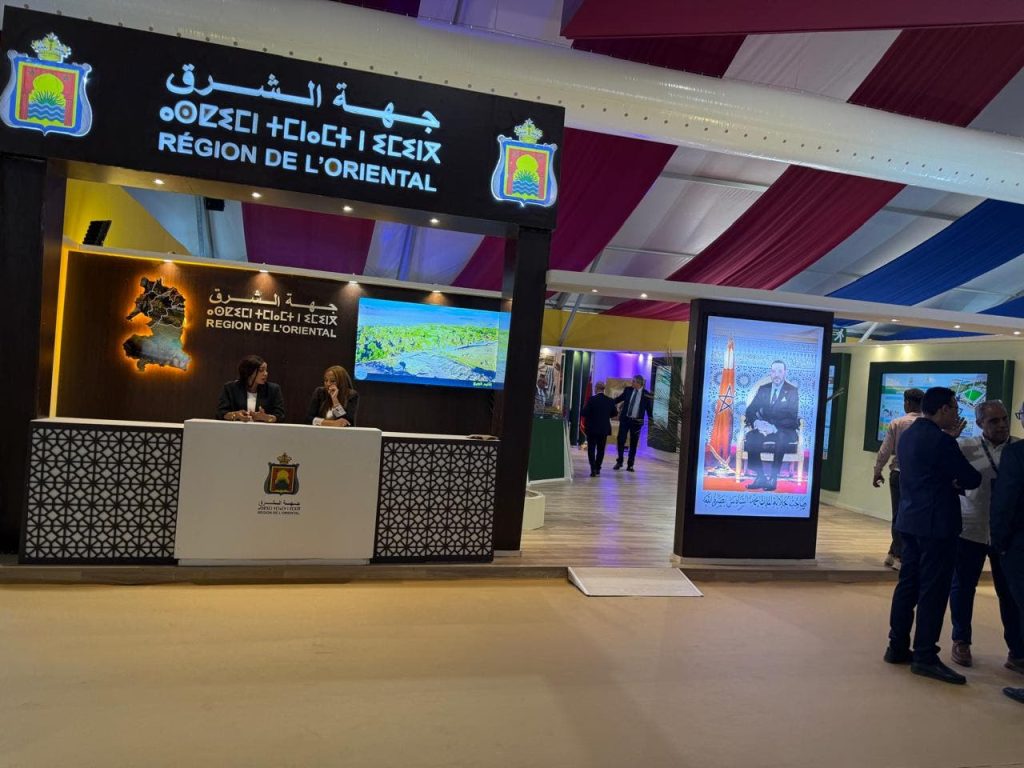
Under the slogan "Sustainable Management of Global Resources as the Basis for the Development of Date Palms and Oases," the Regional Directorate of Agriculture in the Oriental Region participated strongly in the activities of the 14th edition of the International Dates Exhibition in Erfoud, which was organized under the supervision of the Ministry of Agriculture, Maritime Fisheries, Rural Development, Water and Forests, from October 29 to November 02, 2025.

This presence confirms the continuous involvement of the Oriental Region in the strategy to develop the Fekik oases, which is a fundamental pillar for socio-economic and spatial development, and a model to be emulated in applying the principles of sustainable development within the oasis area.
In this regard, the Regional Directorate of Agriculture in the Oriental Region, within the framework of the "Green Generation 2020-2030" plan, is working on implementing a package of integrated projects that aim to enhance water resources, valorize natural resources, and raise agricultural productivity within the Fekik oases, which cover an area exceeding 11,500 hectares. These projects represent a model for efforts to rationalize water use in the agricultural sector.
The most prominent achievements and projects under implementation include:
– Water transfer project from the Al-Saqia Al-Hamra dam and the ridge: With a total cost of 250 million dirhams, the project will enable the mobilization of about 10 million cubic meters annually for the benefit of the Fekik oases.
– Water transfer project from the Khankrou facility: This project is under construction and is expected to strengthen the water supply in the oases of Bani Tadjit, Bouanane and Ain Chawater by about 10 million cubic meters.
– Water infrastructure: Establishment and equipping of 66 water points to ensure water supply to the inhabitants of the oases.
– Improving irrigation networks: Rehabilitation and improving the efficiency of the traditional irrigation network over an area of approximately 3,500 hectares (2020-2024), with an investment estimated at 60 million dirhams, which will save more than 5 million cubic meters of water annually.
– Local irrigation (conversion): The total area equipped with a drip irrigation system has reached more than 8,900 hectares, and this program contributes to saving more than 20 million cubic meters of water annually.
The date palm chain is also one of the main pillars of economic and spatial development in the Fekik oases. Sectoral programs have yielded significant results during the 2024-2025 agricultural season, where the total planted area reached 2,630 hectares. The recorded production during the current agricultural season is estimated at about 10,500 tons, with expectations of reaching 14,000 tons by 2030, thanks to the expansion of areas and the improvement of techniques.
– Economic value: This series provided 97,000 working days during the agricultural season, and it is expected to achieve a significant turnover of around 400 million dirhams.
– Diversity and quality: The Fekik oases are rich in a great variety of varieties, the most prominent of which are "Aziza Bouzid", "Al-Aslawi", "Boufeggous", and "Boufeggous Aras", which are varieties of high quality and outstanding productivity.
– Valorization and professional organization: The chain has witnessed remarkable development in terms of valorization and organization, through the establishment of 7 units for packaging and valorization of dates, the establishment of two economic interest groups, the structuring of 30 agricultural cooperatives and 14 associations for water users for agricultural purposes.
The Regional Directorate continues to support producers through technical and logistical support programs, encourage coding and distinctive marks of origin and quality, and facilitate participation in various exhibitions.
The participation of the Oriental Region in the International Dates Exhibition in Erfoud 2025 confirms its firm commitment to enhancing the sustainable development of oases, valorizing local spatial products, supporting the resilience of oasis systems and climate change.
This participation embodies the vision of the Ministry of Agriculture to achieve sustainable, innovative and inclusive agriculture that effectively contributes to improving the living conditions of the local population and strengthening the economic and social dynamics of the Oriental Region.