HIBAPRESS
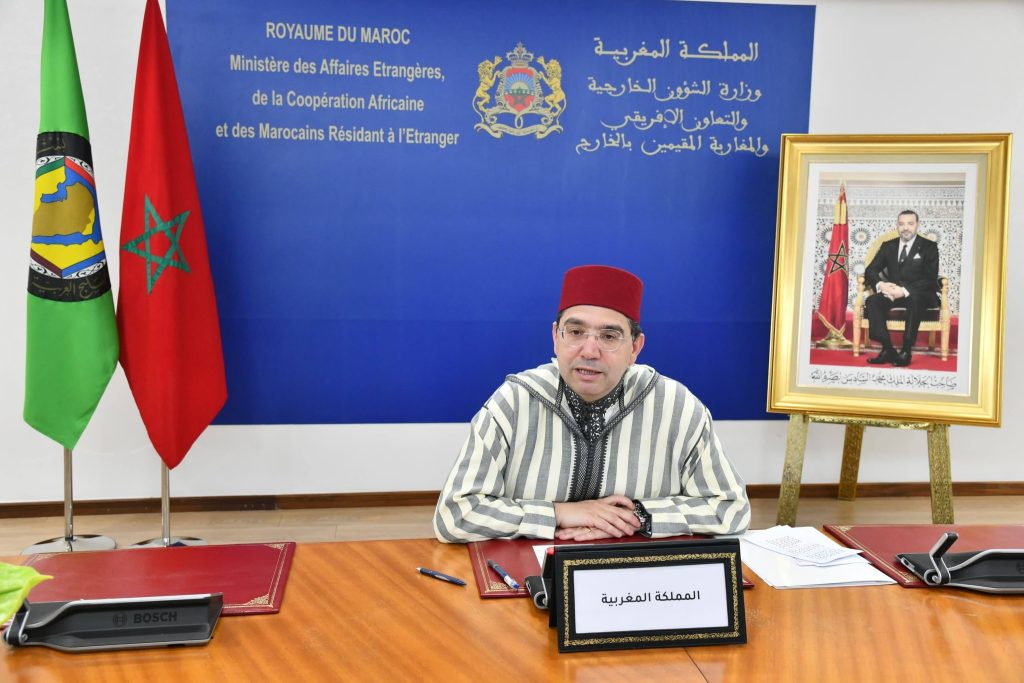
Nasser Bourita, Minister of Foreign Affairs, African Cooperation and Moroccan Expatriates, confirmed on Thursday that the phone calls made by King Mohammed VI with a number of leaders of the Gulf Cooperation Council countries due to the brutal Iranian aggression express the firm and steadfast brotherly solidarity of Morocco with these countries.
Bourita said, before the eighth joint ministerial meeting between Morocco and the Gulf Cooperation Council for Arab States, which was held via video conferencing technology, that “the phone calls made by His Majesty King Mohammed VI, may God protect him, with a number of his brothers, the leaders of the Cooperation Council countries, translated the highest expression of this firm and steadfast brotherly solidarity.” He reiterated the Kingdom of Morocco’s full support and strong support for its brothers, the Gulf Cooperation Council countries, in the face of the brutal, condemned, and unjustified Iranian aggression to which they were exposed, and its standing with them in all the measures they take to defend themselves, protect their sovereignty, preserve their security, and ensure the safety of their citizens and residents. He added that this also embodies what His Majesty had previously expressed on the occasion of his speech before the Moroccan-Gulf Summit on April 20, 2016, where His Majesty affirmed that "despite the geographical distances that separate us, we are united, thank God, by strong ties that are not only based on language, religion, and civilization, but also based on adherence to the same values and principles, and the same constructive orientations. We also share the same challenges, and face the same threats, especially in the security field.” In the same context, Bourita affirmed that "the challenges facing our region today require us to upgrade our strategic partnership to a higher level of integration," adding that "national security is no longer limited to the military dimension only, but has come to include the ability to withstand economic and social crises, and securing the basic needs of our peoples in the most difficult circumstances.” He affirmed the Kingdom of Morocco's determination, under the guidance of King Mohammed VI, to move forward with its strategic partnership with the Gulf Cooperation Council countries to broader horizons, guided by the guidance of our leaders on the basis of the stability of values and pillars and the dynamism of content, which enables us all to keep pace with the developments of the era in service of the interests of our countries and the aspirations of our peoples in development, progress, and prosperity. He pointed out that “the basic pillars of our strategic partnership are based on solidarity and cooperation between the Kingdom of Morocco and its brothers, the Gulf Cooperation Council countries, as well as on the harmony of our positions towards many regional and international issues.” Bourita urged the need to unite ranks and prepare politically and economically for the world after these events, so that we can be strongly present in formulating the new equations. In this context, the minister affirmed the need to translate the directives of the Moroccan-Gulf summit, which was held on the land of the Kingdom of Saudi Arabia on April 20, 2016, into concrete programs in various fields, taking into account the tangible development witnessed by Morocco and the Gulf countries thanks to ambitious development models that aim to adapt and benefit from the economic and technological transformations taking place in the world. He praised the decision to extend the joint action plan to include the period 2025-2030, as well as what was adopted regarding focusing cooperation during the next two years. Bourita stressed the need to include a greater number of private economic actors from both sides and to encourage communication between them, and on the active involvement of sovereign funds, especially in the fields of investment and the mobility of businessmen. On the other hand, the Minister of Foreign Affairs again praised the steadfast support that the fraternal Gulf countries provide to the Kingdom of Morocco regarding the issue of its territorial integrity. He affirmed that a just settlement of the Palestinian issue constitutes the key to security and peace in the region, stressing that, and based on this vision, King Mohammed VI, President of the Al-Quds Committee, has been calling for the concerted international and regional efforts in order to find a just and permanent solution to the Palestinian issue, within the framework of the two-state solution, so that the Palestinian people can obtain their legitimate rights, foremost of which is their right to establish their independent state, on the borders of June 4, 1967, with East Jerusalem as its capital.